
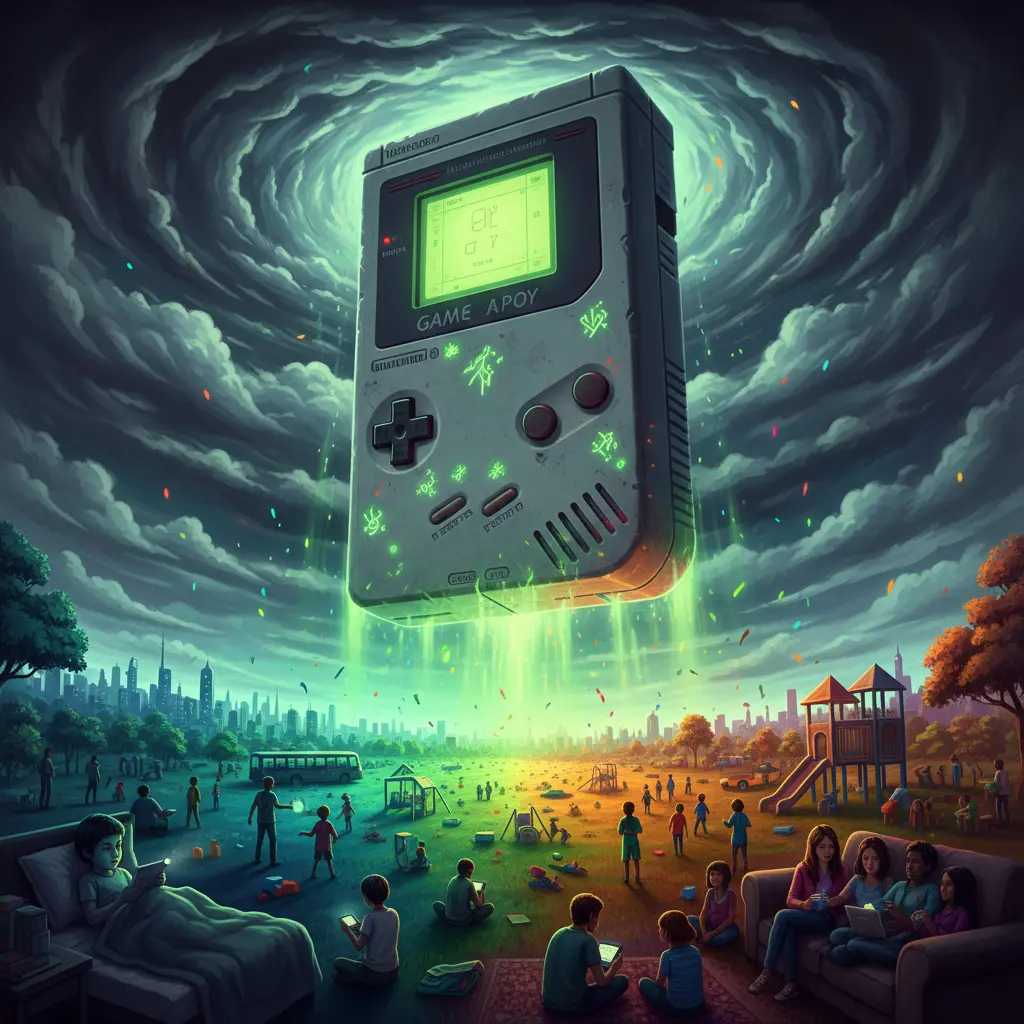

The Gray Brick That Set Gaming Free
One Game Boy survived a Gulf War bombing and still works today. That’s not just durability—that’s a testament to how Nintendo built a device that refused to quit, much like the generation that clutched it on school buses, in waiting rooms, and under bedcovers with flashlights past curfew.

When Nintendo launched the Game Boy in 1989, they weren’t selling cutting-edge technology. Competitors had color screens, faster processors, and better specs across the board. What Nintendo offered was something more revolutionary: gaming you could take anywhere, that lasted longer than your attention span, and didn’t break when your little brother threw it down the stairs. The Game Boy didn’t just create portable gaming—it democratized it, turning video games from expensive living room fixtures into pocket-sized companions that traveled with an entire generation.
This is the story of how a device with a green-tinted screen and calculator chips became one of the most culturally significant pieces of technology of the late 20th century.
What Made the Game Boy Different (And Why That Mattered)
Designer Gunpei Yokoi believed in “lateral thinking with withered technology”—using affordable, proven tech in creative ways instead of chasing bleeding-edge specs. While Atari pushed the Lynx with its color screen and Sega promoted the Game Gear’s technical superiority, Yokoi focused on three things: battery life, durability, and price.

The Game Boy lasted 10-15 hours on four AA batteries. Its competitors? 3-5 hours, max. When you’re a kid begging for batteries at the grocery store or a parent tired of replacing them, that difference matters. Nintendo understood that portability means nothing if your device dies before you reach your destination.
That chunky gray plastic shell wasn’t just aesthetic—it was engineered to survive real-world use by actual children. Drop it, step on it, leave it in a hot car—the Game Boy survived conditions that would murder modern smartphones. This wasn’t luxury technology; it was utilitarian design at its finest, built for the chaos of actual life.
And the price? $89.99 at launch. Compared to the Lynx at $179.99 or the Game Gear at $149.99, Nintendo made handheld gaming accessible to families who couldn’t afford premium electronics.

The Revolution Started With Falling Blocks
Bundling Tetris with the Game Boy was a masterstroke that transcended marketing. While competitors tried selling their handhelds with action games requiring quick reflexes and good screens, Nintendo paired their device with a puzzle game that worked perfectly on a monochrome display and appealed to literally everyone.
Tetris sold over 35 million copies, but more importantly, it made the Game Boy a cultural phenomenon beyond traditional gamers. Your parents played it. Your grandparents played it. Office workers played it on lunch breaks. The devices became the first gaming device that didn’t require you to be “a gamer”—it was just fun, accessible, and addictive for anyone with thumbs and curiosity.
This democratization mattered. Gaming had been largely marketed to boys and young men, but Tetris on this device reached across demographics in ways the industry hadn’t seen. Women bought Game Boys. Adults bought them for themselves, not just their kids. The device became normalized in spaces where gaming had previously been seen as childish or niche.

Building a Library That Defined Childhoods
Specs don’t create memories—games do. While competitors argued processor speeds and screen technology, Nintendo focused on building a library that made people actually want to play their device.
Super Mario Land proved platformers could work on a handheld screen, translating Nintendo’s mascot into pocket-sized adventures without losing the magic. The Legend of Zelda: Link’s Awakening delivered a full-fledged Zelda experience that still ranks among the series’ best games, proving handheld titles could match console quality.
But the game that changed everything? Pokémon Red and Blue.

When Link Cables Became Social Currency
Pokémon transformed the Game Boy from individual entertainment device to social phenomenon. Suddenly, that link cable connecting two Game Boys wasn’t just a technical feature—it was how you traded Pokémon with friends, how you completed your Pokédex, how you proved you’d caught that rare Charizard everyone wanted.
Playgrounds became trading floors. Game stores set up kiosks for tournaments. Schools banned Game Boys because kids couldn’t stop playing during lunch. The device created a new form of childhood social capital based on digital creatures living in your pocket.

This wasn’t just gaming—it was community building through technology. The Game Boy enabled a form of local multiplayer that required face-to-face interaction, creating social experiences around gaming that today’s online connectivity often lacks. You had to meet up with friends, sit together, connect your devices physically. Those interactions became core memories for millions of kids growing up in the late ’90s.

Evolution Without Abandonment
Nintendo didn’t just release the Game Boy and move on. They iterated, improved, and evolved the platform while maintaining backward compatibility—a decision that kept the ecosystem growing instead of fracturing.
The 1996 Game Boy Pocket shrunk everything down, making the device truly portable instead of just technically portable. In 1998, the Game Boy Color added what the name promised while still playing original Game Boy games. The 2001 Game Boy Advance represented a generational leap while respecting the legacy.

Each iteration brought new capabilities without abandoning existing owners. Your old games still worked. Your Game Boy cartridge collection didn’t become obsolete. Nintendo understood that respecting customers’ investments builds loyalty—a lesson the gaming industry keeps forgetting and relearning.

Why Nostalgia Alone Doesn’t Explain Its Legacy
Yes, millions of people remember unwrapping Game Boys on birthdays and holidays. But the device’s cultural impact runs deeper than fond memories. The Game Boy normalized portable computing before smartphones existed, proving people wanted to carry technology with them throughout their days.
It democratized gaming by making it affordable and accessible across demographics. It created new forms of social interaction through multiplayer connectivity. It proved that battery life and durability mattered more than cutting-edge specs—a lesson that resonates today as consumers choose practical devices over flashy ones.
The Game Boy taught an entire generation that technology could be personal, portable, and yours in ways that shared family computers and living room consoles never quite achieved. That gray brick was privacy, independence, and adventure all contained in something you could slip into a backpack.

How to Experience It Today
Modern audiences curious about the console have multiple entry points:
Original Hardware: Game Boys and Game Boy Colors are still surprisingly affordable on the used market. Pair one with the right games, and you can experience gaming history as it was meant to be played. There’s something authentic about dealing with real cartridges, AA batteries, and that distinctive green screen.
Modern Handhelds: Devices like the Analogue Pocket provide upgraded screens and modern conveniences while playing original cartridges. You get the authentic game experience with contemporary quality-of-life improvements.

Emulation: Legal game preservation through emulation allows you to explore the entire Game Boy library digitally. While this lacks the tactile experience of original hardware, it’s the most practical way to discover the depth of the platform’s catalog.
Essential Games That Define the Experience
If you’re exploring the Game Boy for the first time, these titles capture what made the platform special:
Tetris remains the essential Console experience—simple, elegant, endlessly replayable. This is where you understand why the device succeeded.

Pokémon Red or Blue represents the console’s at its cultural peak. These aren’t just games; they’re generational touchstones that defined childhood for millions.

The Legend of Zelda: Link’s Awakening proves handheld games could deliver console-quality experiences. The storytelling, world design, and emotional resonance hold up decades later.
Super Mario Land 2: 6 Golden Coins showcases how Nintendo adapted their flagship franchise for portable play while introducing Wario, one of gaming’s greatest antiheroes.

Metroid II: Return of Samus demonstrates the Game Boy could handle atmospheric, exploration-focused gameplay that went beyond simple pick-up-and-play experiences.

The Cultural Legacy Beyond Gaming
The device’s influence extends far beyond video game history. It proved portable electronics could be mass-market consumer products years before smartphones made that concept obvious. It demonstrated that practical design beats cutting-edge specs when it comes to actual usability—a lesson Apple would later build an empire on.
The device normalized carrying entertainment technology in public spaces, making it socially acceptable to play games on buses, in waiting rooms, and during commutes. That cultural shift paved the way for today’s smartphone gaming and mobile entertainment culture.
Most significantly, the Game Boy showed that technology could bring people together through shared experiences rather than isolating them. Those link cable connections, those playground Pokémon trades, those moments of playing side-by-side with friends—they created community through technology in ways that feel increasingly rare in our current online-first world.

The Console Today
Decades after its release, the console remains relevant not as nostalgia object but as proof that good design, strong software libraries, and understanding your audience matter more than technical specifications. Every modern portable gaming device, from the Nintendo Switch to the Steam Deck, exists because the Game Boy proved the market wanted gaming freedom.
The device taught the industry—and consumers—that portability requires compromise, but those compromises can be features rather than limitations when designed thoughtfully. Long battery life isn’t flashy, but it’s essential. Durability doesn’t excite tech reviewers, but it matters to actual users. Affordability doesn’t make headlines, but it determines who gets to participate.
These lessons remain evergreen because they’re about human needs rather than technological trends. We still want devices that last all day, survive real-world conditions, and don’t require second mortgages to purchase. The Game Boy understood this in 1989, and that wisdom continues resonating today.
The Brick That Wouldn’t Break
That Gulf War Game Boy sits in the Nintendo New York store today, slightly melted but still functional. It’s become a symbol of what the device represented: resilience, accessibility, and the democratization of gaming. Millions of devices survived childhoods, adolescences, and young adulthoods, carrying entire libraries of experiences in their cartridge slots.
The device didn’t just survive—it transformed how we think about portable technology, social gaming, and what makes electronics truly valuable. It proved that the best technology isn’t always the most powerful; sometimes, it’s simply the technology that shows up, works reliably, and becomes part of your daily life.
Thirty-plus years later, that gray brick with the green screen remains one of gaming’s most significant innovations—not because of what it could do, but because of what it enabled millions of people to experience.
Want more gaming stories? Check out Our Fortnite Lore Narrative Chaos, The Ultimate Guide to Minecraft or Halo’s lore explained.
For more of interactive storytelling: Gaming Meets Movies


Leave a Reply