
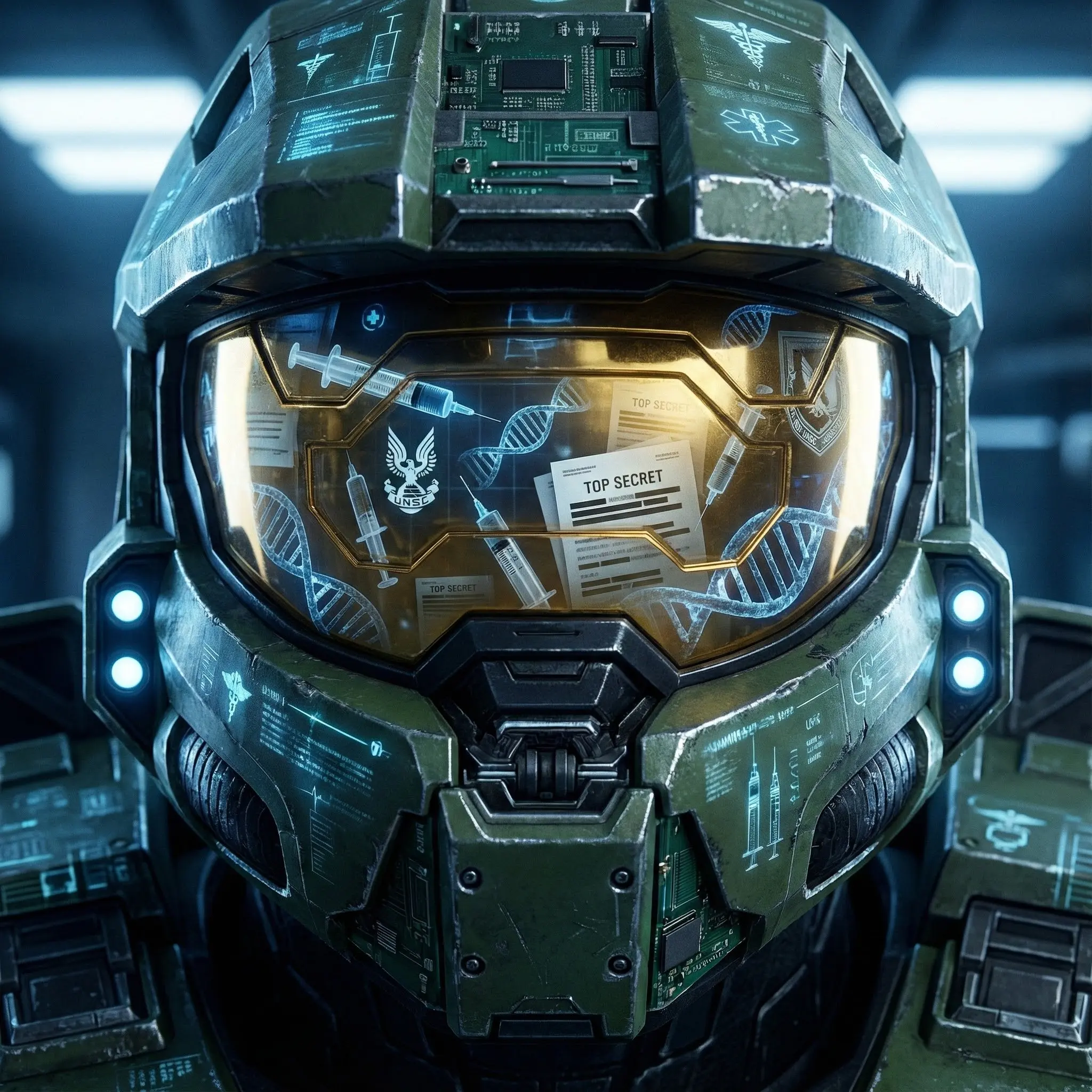

I need to tell you something about Halo Master Chief lore. Something that’s going to ruin those feel-good moments when he saves humanity for the umpteenth time. Most Halo players never learn this. Bungie and 343 Industries have spent two decades carefully avoiding the full implications of their own story.
Master Chief isn’t just a super soldier. He’s a victim of government-sanctioned child trafficking. The UNSC turned him into a weapon before he spell his own name. The deeper Halo Master Chief lore that exists beyond the games reveals one of gaming’s most morally bankrupt origin stories. It’s wrapped up in shiny armor and served with a side of “heroic sacrifice.”

Here’s what gets me: I’ve been covering games for years. I’ve watched millions of players cheer for John-117. Yet they never question what the UNSC actually did to create their perfect soldier. The games want you focused on alien threats, mysterious rings, and AI companions with daddy issues. They definitely don’t want you thinking about your hero’s true origins.
But maybe it’s time we did think about it. Because Master Chief’s backstory isn’t just darker than you realize. It’s darker than most people can handle.
The Childhood Kidnapping Behind Master Chief
Let me paint you a picture of March 7th, 2517. Six-year-old John is playing in his backyard on Eridanus II. He’s probably doing normal kid things like picking his nose. Maybe he’s wondering why adults are so weird. He’s taller and stronger than other kids his age, but he’s still just a child. What he doesn’t know is that Dr. Catherine Halsey is watching him. She’s evaluating him like livestock.

The Spartan-II program needed children. Adults couldn’t survive the augmentation process. So Halsey identified 75 kids with “superior genetic markers.” Basically, children who won the biological lottery in all the worst ways. John was one of them. However, they didn’t select him for his potential to be happy or fulfilled. They chose him for his capacity to become an efficient killer.
Here’s where the Halo Master Chief lore gets truly stomach-churning. The UNSC didn’t ask permission. They didn’t negotiate with parents or offer alternatives. They straight-up kidnapped these children. Then they replaced them with flash clones—genetic copies designed to die within weeks or months. This gave families the illusion that their kids had succumbed to illness or accidents.

Think about that for a second. John’s parents buried what they thought was their son. They grieved, moved on, maybe had other children. Meanwhile, their actual child was being subjected to military indoctrination. The physical modifications would fundamentally alter his humanity. The Halo expanded universe treats this as a necessary evil. But let’s call it what it really is: war crimes with a sci-fi coat of paint.

Military Training or Child Abuse?
What happened to John and the other Spartan-II candidates between ages 6 and 14 wasn’t education. It was systematic dehumanization. The goal was creating perfect soldiers who couldn’t function in normal society.

Chief Petty Officer Franklin Mendez ran the program. It was like a cross between boot camp and a psychological experiment. Children were subjected to military discipline, combat training, and educational programs. These replaced normal childhood development with tactical knowledge and weapons proficiency. They learned how to kill before they learned how to drive.

But here’s the part that really gets me about John-117’s origin story. This wasn’t an emergency measure. The Covenant threat didn’t even exist yet. The Spartan-II program was originally designed to fight human rebels. The Insurrectionists wanted independence from Earth’s government. Halsey created child soldiers to fight other humans who just wanted self-determination.
When the Covenant showed up in 2525, suddenly the program had a more palatable enemy. Alien religious fanatics trying to wipe out humanity? Perfect. That’s a threat everyone can get behind stopping. The fact that these super soldiers were originally intended to suppress human freedom fighters? Well, that’s just an uncomfortable detail we don’t need to dwell on.

The Brutal Augmentation Process was key in the Master Chief lore
At 14, John and his fellow candidates faced the augmentation process. This involved a series of medical procedures designed to enhance their physical capabilities beyond human limits. The official Halo lore describes this in clinical terms. But let me translate: they performed experimental surgery on children without their meaningful consent.

The augmentations included several procedures. Carbide ceramic ossification strengthened bones. Muscular enhancement injections boosted physical power. Catalytic thyroid implants altered metabolism. Superconducting fabrication rewired neural dendrites. In simpler terms: they turned children’s skeletons into metal. They pumped them full of performance-enhancing chemicals. They rewired their nervous systems and altered their brain chemistry.

Half the candidates died. Others were crippled for life. John was one of only 33 who emerged from the process physically intact. But “intact” is relative when you’re talking about someone who’s been fundamentally altered at the genetic and neurological level.
Here’s what really bothers me: the games present Master Chief’s superhuman abilities as cool gameplay mechanics. Enhanced reflexes! Increased strength! Advanced tactical thinking! What they don’t emphasize is the cost. These abilities came at the expense of his ability to relate to normal humans or exist outside of military structure.
Games vs. Books: A Study in Sanitization
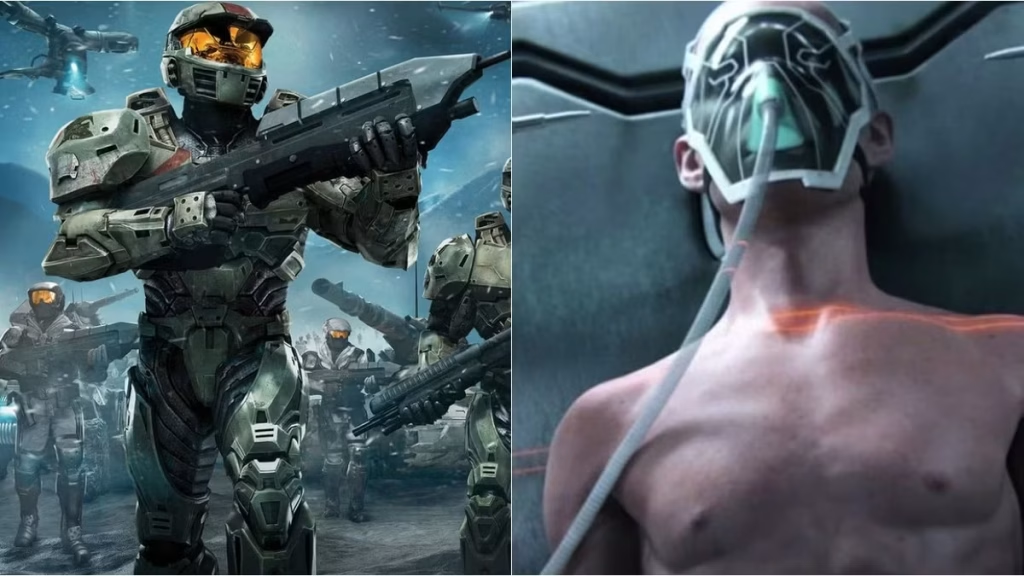
This is where my criticism of the Halo franchise gets really pointed. The mainline games—Combat Evolved through Infinite—deliberately avoid the darker implications of Master Chief’s backstory. You play as this unstoppable supersoldier saving humanity. The games want you to feel heroic about it.

But the expanded universe tells a different story. Books like “The Fall of Reach,” “Silent Storm,” and “Shadows of Reach” don’t shy away from the moral complexity. They acknowledge that these characters are victims as much as heroes. Trauma and conditioning shaped them into weapons that barely qualify as human anymore.
The games give you glimpses. Chief’s awkwardness around civilians. His complete inability to function outside military command structure. His dependence on AI guidance for basic social interaction. But they frame these as endearing quirks rather than symptoms of severe psychological conditioning.
Even Halo 4’s attempt to humanize Master Chief through his relationship with Cortana sidesteps the fundamental question. Who is John-117 when people constructed his entire identity? They saw him as a tool, not a child.
Why the Halo Master Chief Lore Matters More Than You Think
“Okay Jin,” you might be saying, “but it’s just a video game. Why are you taking this so seriously?” Because stories matter. Especially stories we tell ourselves about heroism, sacrifice, and the acceptable costs of protecting society.
Master Chief’s story, when examined honestly, reveals how institutions justify horrific acts in the name of security. It’s about how we create heroes by destroying the people who might have lived normal, happy lives. It’s about the price of victory when that price is paid by those who never got to choose.

And here’s the really uncomfortable part: it worked. The Spartan-II program, despite its moral bankruptcy, created soldiers who saved humanity from extinction. John-117 prevented the activation of the Halo Array. He stopped the Flood and preserved human civilization. The ends, in this case, arguably justified the means.
That should terrify you. If we can accept child trafficking when the stakes are high enough, what becomes justifiable? Can we also accept medical experimentation? The Halo Master Chief lore forces us to confront the question: how far should society go to protect itself?
The Character Development That Never Happened
Here’s my biggest criticism of how the games handle Master Chief. They’ve had over 20 years to meaningfully address the psychological implications of his origin story. They’ve consistently chosen not to.
Chief should be deeply traumatized. He should struggle with identity, purpose, and human connection in ways that go beyond “strong silent type” tropes. The games hint at this—his attachment to Cortana, his discomfort with praise, his inability to retire. But they never fully commit to exploring what it means to be a person. His entire sense of self was constructed by military programming.

Compare this to other franchises that tackle similar themes. Captain America grapples with being a man out of time. Wolverine struggles with the gap between his programmed identity and his actual self. But Master Chief remains largely static. He’s defined more by what he does than who he is.
John-117’s backstory could support incredible character development. What happens when a person created to be a weapon tries to figure out how to be human? How does someone whose entire identity was constructed by others learn to make choices for themselves? These are fascinating questions that the games mostly ignore in favor of “shoot aliens, save universe, repeat.”
Essential Reading for Full Halo Master Chief Lore
If this article has convinced you to dig deeper into the actual story behind John-117, here’s where to start:
Essential Reading:
- Halo: The Fall of Reach by Eric Nylund – The original novel that reveals John’s kidnapping and training
- Halo: Silent Storm by Troy Denning – Shows young Master Chief’s first major operations
- Halo: Shadows of Reach by Troy Denning – Deals with the psychological aftermath of the Spartan program
For the Complete Picture:
- Halo: First Strike by Eric Nylund – Bridges the gap between games while exploring trauma
- Halo: Ghosts of Onyx by Eric Nylund – Shows what happened to other Spartan-II survivors
Visual Media:
- Halo: The Fall of Reach animated series – Adaptation of the original novel
- Halo Legends: The Package – Shows Blue Team in action and their relationships
The Truth We Need to Face
Master Chief’s story forces us to confront an uncomfortable reality. Sometimes the people we celebrate as heroes are actually victims who never had the chance to be anything else. John-117 didn’t choose to be a supersoldier. Others made that choice for him when he was six. They saw his potential for violence as more valuable than his potential for happiness.
This doesn’t make him less heroic. If anything, it makes his actions more meaningful. He chooses to protect humanity even though he has every reason to resent the institutions that created him. This choice shows a level of moral character that transcends his programming.
But it should change how we think about the cost of heroism. Master Chief’s backstory isn’t just about alien invasions and ancient weapons. It’s about what happens when society decides that some people are worth sacrificing for the greater good.
The really twisted part? In the world of Halo, that calculation was probably correct. Humanity needed the Spartans to survive. The Covenant would have wiped out our species without supersoldiers to oppose them. The mathematical ethics are clear: sacrifice 75 children to save billions of lives.

But math doesn’t account for the human cost of those calculations. It doesn’t factor in the childhood that John never had. It doesn’t consider the normal life he’ll never experience. And it ignores the fundamental questions about identity and purpose that he’ll never be able to answer.
That’s the real tragedy of John-117’s origin story. Not that these sacrifices were made, but that we’ve spent 20 years celebrating them without fully acknowledging what they cost.
Next time you boot up a Halo game and watch Master Chief save the universe, remember this. You’re not just controlling a supersoldier. You’re controlling someone who never got the chance to be anything else.
Master Chief, Halo and all related characters, names, marks, emblems and images are trademarks of Microsoft. This content is transformative commentary and review material created by Fandoria and is not affiliated with or endorsed by the companies mentioned.


Leave a Reply