
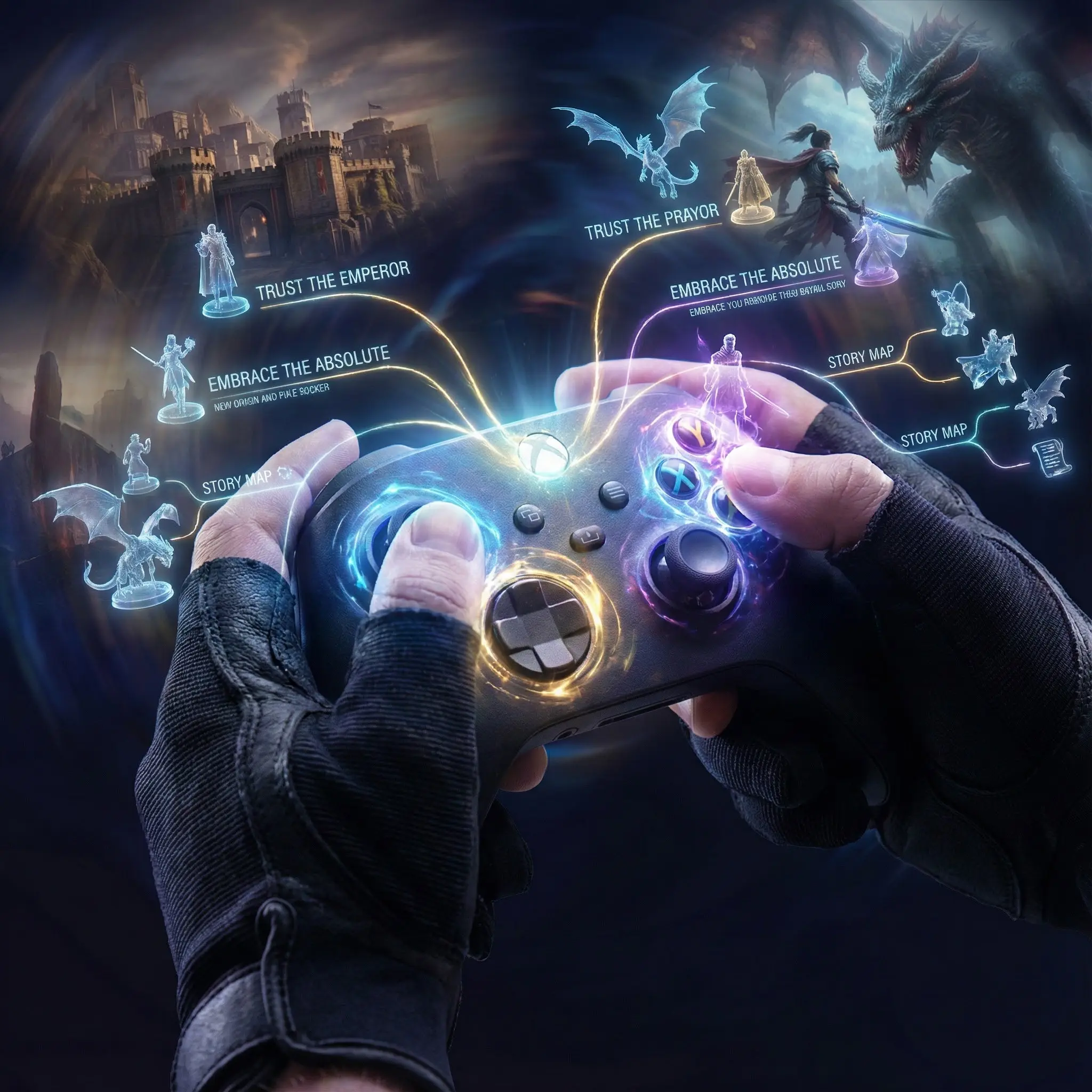

You’re sitting in a movie theater watching the hero face an impossible choice. Your brain screams “DON’T TRUST HIM!” but the hero trusts anyway because the script says so. Meanwhile, your friend just spent three hours in Baldur’s Gate 3. They were agonizing over whether to save a village or chase the villain. Their choice actually mattered, showing interactive storytelling at its best.
That’s the difference between watching a story and living one.

The Revolution Hiding in Plain Sight
While Hollywood churns out superhero sequel #47, something wild is happening in gaming. Interactive storytelling has evolved from simple button presses to full-blown cinematic experiences where you write the story.
Baldur’s Gate 3 delivers 140 hours of branching narratives. Final Fantasy VII Rebirth creates emotional moments that hit harder than Oscar winners. Indiana Jones and the Great Circle feels more like classic Spielberg than actual recent Indiana Jones movies.
Here’s the thing Hollywood doesn’t want to admit: gaming meets movies in a way that makes traditional cinema look… well, old-fashioned.

When You Become the Director
Remember Choose Your Own Adventure books? Gaming just turned that concept into a multi-million dollar art form.
The Psychology of “My Story”
When you watch a movie, you see. When you play Baldur’s Gate 3, you create. That psychological shift changes everything about how we connect with characters.
I spent 30 hours building relationships in Final Fantasy VII Rebirth. When Cloud made his big sacrifice, it wasn’t just a character moment. It was the payoff of dozens of choices I’d made.
Try getting that emotional investment from a two-hour movie where you’re just along for the ride.

The Ten-Minute Choice
Here’s a moment that perfectly captures why interactive storytelling is eating Hollywood. I faced a burning building in Baldur’s Gate 3. Save the people inside, or chase the villain who will escape forever?
I sat there for ten actual minutes. Not because the game froze, but because I knew my choice would ripple through the entire story. NPCs would remember. The ending would change. Everything was on the line.
When’s the last time a movie made you pause and truly wrestle with a character’s decision?

The Tech Revolution That Hollywood Missed
Games don’t just look as good as movies anymore – they look better.
Motion Capture Magic
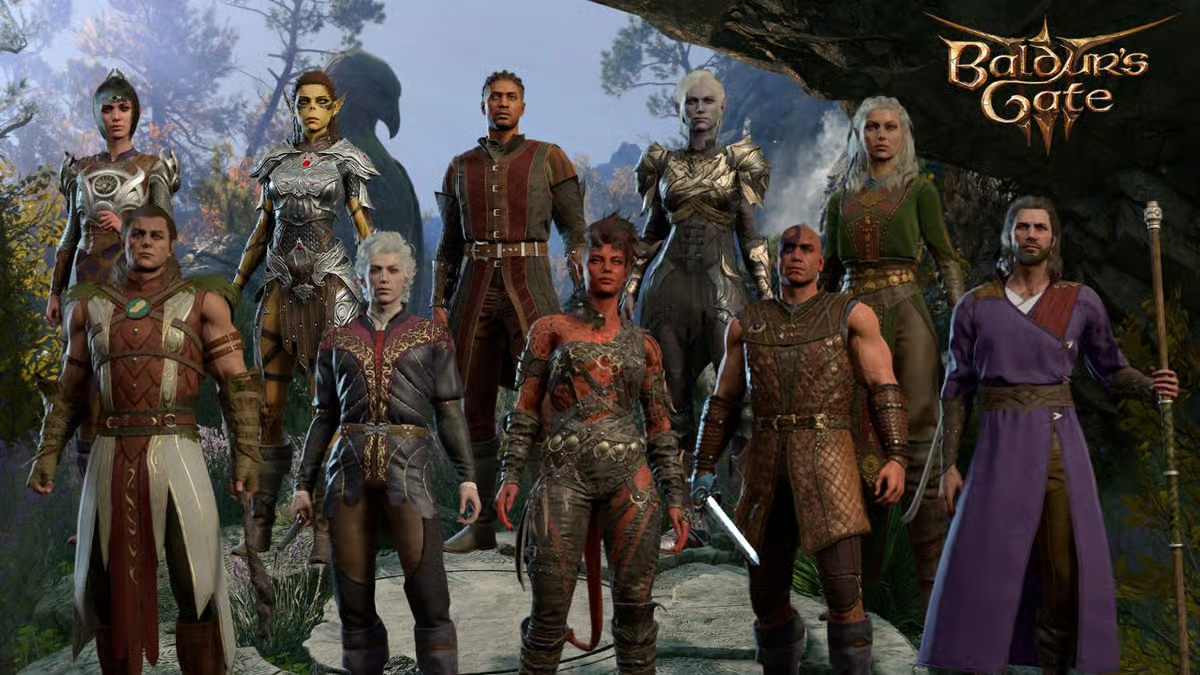
Baldur’s Gate 3 used 248 voice actors with full motion capture. When Astarion smirks, that’s real actor Neil Newbon’s actual smirk translated perfectly to pixels. When Shadowheart shows doubt, those are Jennifer English’s real facial expressions.
It’s not just better than animation. It’s also better than most live-action. Actors can embody impossible characters without physical limits in such productions.

Real-Time Rendering vs. Locked Films
Movies are shot months ahead and locked into one version. Games like The Last of Us Part II create every scene live based on your specific choices. Every conversation adapts to your unique story path.
That’s not just technical wizardry – that’s personalized cinema.
The Budget Battle Gaming Already Won
Baldur’s Gate 3: $100 million, 140+ hours of content, multiple endings, full voice acting, orchestra music.
Average Marvel movie: $200 million, 2 hours, one ending, seen it all before.
Gaming meets movies in the budget department, and gaming wins on pure value. $60 for 200+ hours vs. $20 for 2 hours? The math isn’t even close.
But here’s the kicker: replay value. You rewatch a great movie 2-3 times. You’ll replay Baldur’s Gate 3 five times to see different story outcomes. Movies can’t compete with that.
Hollywood’s Panic Responses (And Why They’re Missing the Point)
Netflix tried interactive content with Black Mirror: Bandersnatch. It flopped because they gave viewers maybe 10 choices across 90 minutes. Baldur’s Gate 3 gives meaningful choices every few minutes across 140+ hours.
The difference? Netflix bolted choices onto a linear story. True interactive storytelling makes choice the entire story.
Disney’s response? More Marvel movies. While games revolutionize narrative, Disney doubles down on formulaic blockbusters that feel ancient compared to modern game storytelling.
The Games That Prove the Point
5. Silent Hill 2 Remake
Psychological horror that adapts to your choices. When James confronts his trauma, you’re not watching – you’re making the decisions that decide how he processes it.
4. Indiana Jones and the Great Circle
Captures classic adventure spirit better than recent Indy films. You solve the puzzles, make the escapes, choose Indy’s responses. It’s not just interactive – it’s better Indiana Jones.
3. Final Fantasy VII Rebirth
100+ hours of character development that makes every emotional beat feel earned. When Aerith and Cloud share quiet moments, you’ve built that relationship through shared adventure.
2. Metaphor: ReFantazio
Philosophy without pretension. Explores democracy and social change through fantasy, but your choices decide how themes play out. It’s Lord of the Rings written by your decisions.
1. Baldur’s Gate 3
The crown jewel of interactive storytelling. Thousands of player choices create genuinely different stories. Motion-captured performances bring digital characters to life. When I finished my first playthrough, I instantly started a second because I knew the story would be completely different.
No movie offers that experience.
The Engagement Numbers Don’t Lie
Average Netflix session: 45 minutes Average Baldur’s Gate 3 session: 3+ hours!
Movie re-watch rate: 20% Narrative game replay rate: 80%
Gaming meets movies in the attention economy, and gaming absolutely dominates.
Plus, games create communities. When you finish a movie, you post a review. When you finish Baldur’s Gate 3, you share screenshots of your unique story. You discuss choices with friends. You convince others to play for comparison.

The Future Is Already Here
Gen Z grows up with interactive everything – Fortnite concerts, Roblox social experiences, choice-driven narratives. When they become the primary entertainment audience, think they’ll be satisfied sitting passively through two-hour movies?
VR headsets get cheaper (look at my story about VR Haptic Revolution here if you’re into new tech). 5G enables cloud gaming anywhere. AI creates personalized content. All the pieces align to make interactive storytelling the dominant entertainment medium.
Apple Vision Pro is just the beginning. Soon, the line between watching and playing disappears entirely.
What Interactive Storytelling Means for Everyone
Content Creators
Interactivity isn’t optional anymore. Smart YouTubers already ask viewers to vote on story directions. Streamers let chat influence gameplay. TikTokers create choose-your-own-adventure content.
They’re all tapping into the same psychological need that makes games so compelling: agency.
The Corporate Awakening
Disney acquires gaming properties. Netflix launches a gaming division. Amazon invests in interactive content. Traditional media companies see the threat.
But seeing a threat and adapting to it? Very different things.
The Uncomfortable Truth
Passive consumption feels outdated. You can shape Cloud’s relationships in Final Fantasy VII Rebirth. So, why watch a rom-com where you can’t influence the outcome?
You can solve puzzles yourself in Indiana Jones and the Great Circle. Why watch an adventure movie where you’re just along for the ride?

The Agency Revolution
Interactive storytelling provides what movies fundamentally can’t: the satisfaction of authorship. Every choice, every relationship, every consequence in narrative-driven games is partly your creation.
This shift from observer to participant changes how we relate to fictional characters. It makes experiences more personal, memorable, and emotionally impactful.
It’s not just about entertainment – it’s about human psychology. We want to join, not just consume.

The Final Level
The convergence isn’t coming – it’s here. Baldur’s Gate 3, Final Fantasy VII Rebirth, and Metaphor: ReFantazio aren’t just great games. They’re proof that interactive storytelling has evolved beyond traditional media capabilities.
My friend asked why I spent 100+ hours in Baldur’s Gate 3 instead of watching movies. I realized I was explaining the difference between being served a meal and cooking it yourself. Both satisfy, but only one makes you feel like you created something amazing.
That’s the revolution. Gaming meets movies, but gaming offers authorship. It transforms us from passive observers into active participants in stories that shape our emotional lives.
Hollywood can keep making formulaic blockbusters while pretending this isn’t happening. But every hour someone spends crafting their perfect character in Metaphor: ReFantazio is an hour they’re not consuming passive entertainment.

The future of storytelling is interactive, personal, and player-driven.
And honestly? It’s about time.
The most important revolutions happen while everyone’s looking the other way. This one’s happening right in your living room.
For more Universe mythology deep-dives, explore our stories about:


Leave a Reply