
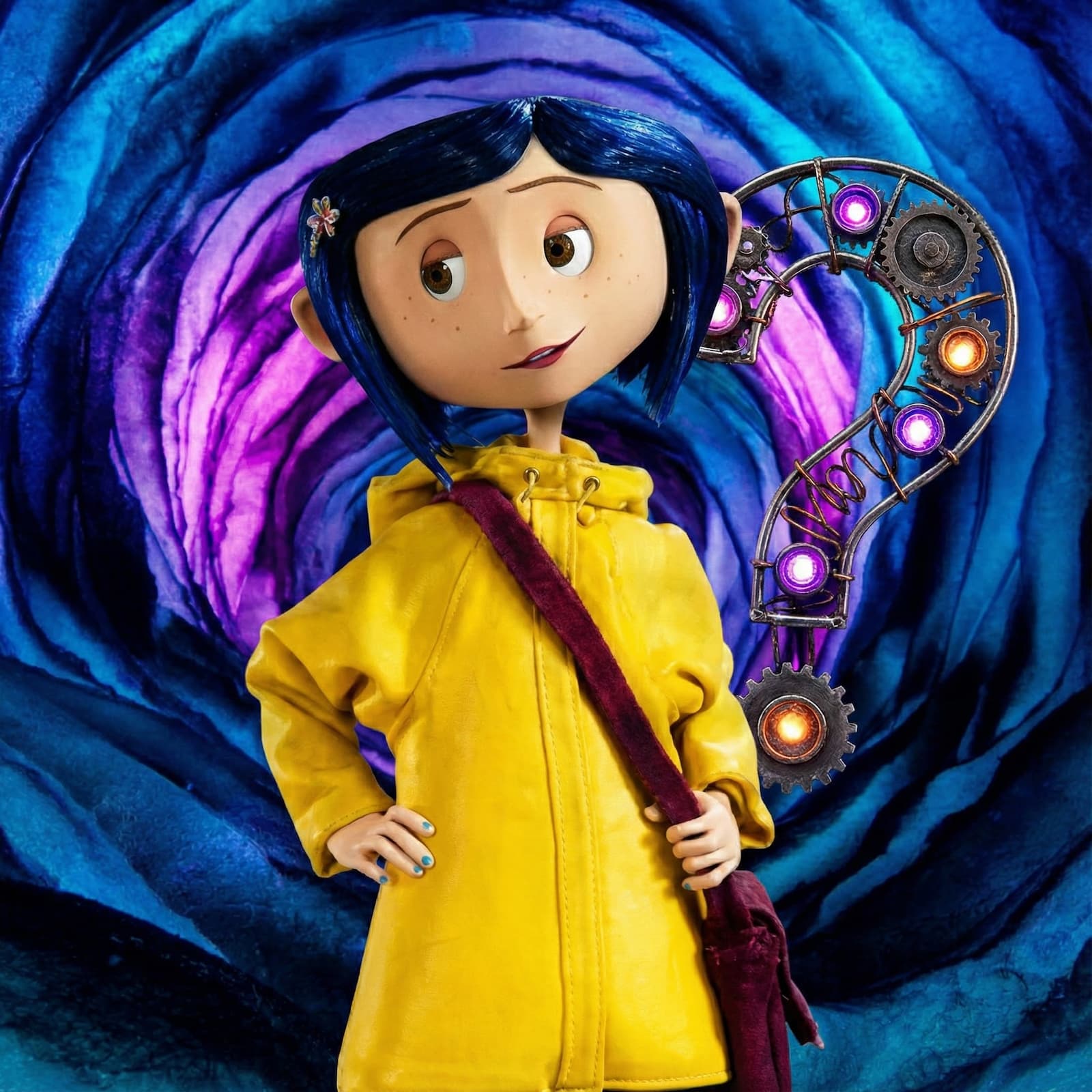

A father standing in a wasp-infested forest, getting stung over and over. His children running to safety. This moment of terror and courage became the beating heart of one of the most psychologically complex children’s stories ever written. Neil Gaiman had to return to the forest later to find his glasses, knowing that the wasps were still there. He then spent a decade crafting “Coraline,” a story he thought would be a simple adventure for kids. Instead, it turned out to be a source of obsession making adults wake up in cold sweats.
What Gaiman couldn’t predict was how viral Coraline theories would multiply across the internet creating a living mythology that continues to evolve. Popular Coraline theories don’t just read like typical fan speculation: They function as instruction manuals for recognizing understanding Coraline’s world. Dive deep into these theories, and you’ll realize this was never really a children’s book., but more of a psychological thriller wearing a fairy tale costume.
The Accidental Typo That Unleashed Internet Horror
Gaiman began writing the book in 1990, intending to type “Caroline.” He hit “Coraline” by mistake, stared at that strange word, and felt something shift. Not because typos are mystical, but because he’d accidentally discovered a character who belonged to an entirely different kind of story.
Here’s what should disturb you: it took him ten years to finish because every time he returned to the manuscript, the story had evolved into something darker than he’d originally planned. As if Coraline was writing herself, becoming more psychologically complex with each revision.
His inspiration came from an ordinary source: a door in his childhood home that opened onto a brick wall. In Middle Eastern storytelling traditions, doors that lead nowhere are considered dangerous thresholds where natural order breaks down. Gaiman had unknowingly been carrying the perfect metaphor for false choices and dead ends disguised as opportunities.
His editor called the finished book “unpublishable.” Children’s horror didn’t exist in mainstream literature. But when Coraline hit the shelves, it earned the Hugo, Nebula, and Bram Stoker awards simultaneously. Critics who dismissed it as “just a children’s book” began using words like “masterpiece” and “genuinely unsettling.”
And then the theories exploded across every platform imaginable.

Viral Coraline Theories That Became An Obsession
TikTok hosts over 5.8 million posts analyzing hidden meanings in Coraline. Adults who loved it as children are returning with horror, recognizing manipulation patterns they missed completely the first time. Reddit threads dissect every frame looking for evidence that the entire “rescue” was an elaborate psychological trap.
But these aren’t typical fan theories about plot holes or character motivations. Disturbing Coraline theories read like academic papers on predatory behavior, systematic breakdowns of gaslighting techniques, and increasingly sophisticated arguments that state that everything we think we know about the story is wrong.
Five major theories dominate the conversation:
- Theory 1 – Afterlife: A fatal car accident leading to another world.
- Theory 2 – Never-Ending Prison: Coraline never actually escaped; the “happy ending” is just another layer of the trap.
- Theory 3 – The Black Cat’s truth: The Black Cat is actually a lost soul.
- Theory 4 – Calculated Sacrifice: Wybie’s grandmother deliberately offered Coraline to protect her grandson.
- Theory 5 – Childhood Trauma: Coraline is actually dealing with childhood trauma and neglect.
Each theory explains details that go beyond a simple good-versus-evil story.

The Afterlife Theory: Coraline Theories About Death
What if everything you think you know about Coraline is wrong from the very first scene?
The most devastating Coraline theory suggests the entire story takes place after a fatal car accident. Coraline and her family died during their move to the Pink Palace, and everything we see is her soul’s journey through purgatory, where she must choose between temptation (the Other Mother) and moving on to the afterlife.
This reframes every “strange” element in the story. Her parents aren’t neglectful – they’re processing their own death, unable to connect properly with their daughter in this liminal space. The Other World isn’t a parallel dimension – it’s a demonic realm designed to trap souls before they can reach peace.
Evidence hides throughout the film: The poison oak that heals mysteriously in the Other World suggests supernatural rather than physical healing. The moving truck that never actually arrives with their belongings. The way adults around Coraline seem disconnected from reality, as if they’re all processing the same traumatic event.
Most chilling detail? The car that nearly hits Coraline and Wybie could be an echo of the accident that killed them all. In this theory, Wybie is another child who died in the crash, and together they’re being tested by forces beyond their understanding.
The Other Mother becomes something far more terrifying than a child-stealing witch. She’s a demonic entity harvesting souls in purgatory, offering eternal comfort in exchange for spiritual damnation. The button eyes aren’t about blindness – they’re about choosing illusion over truth, comfort over salvation.

Prison Disguised as Freedom: Advanced Coraline Theories
One particularly sophisticated Coraline theory suggests she never escaped at all. After her apparent victory, everything becomes suspiciously perfect in ways that should make your skin crawl.
Her previously neglectful parents suddenly become attentive and engaged. Her boring real world magically transforms into something more interesting and fulfilling. Wybie, who was awkward and intrusive throughout the ordeal, becomes a genuine friend who perfectly complements her personality. Mundane problems that drove her to seek the Other World simply… disappear.
This isn’t character development or natural story resolution. This is wish fulfillment engineered with surgical precision.
Evidence hides in plain sight: if Coraline truly defeated an ancient, powerful entity, why is she still in danger? A warning about the Other Mother wanting the door key back only makes sense if the “victory” was another manipulation, designed to make Coraline feel heroic while keeping her exactly where the Other Mother needs her.
Advanced Coraline theories suggest the Other Mother learned from decades of previous victims. Instead of obvious force that triggers resistance, she created an illusion of triumphant escape that satisfies Coraline’s need to feel powerful while maintaining complete environmental control. In Persian literature, this concept appears as nested realities – layers of illusion designed to make escape feel like deeper entrapment.
Traditional fairy tales hint at this pattern, but Coraline perfects it. The “rescue” feels so emotionally satisfying that questioning it seems almost ungrateful. Which is exactly how sophisticated manipulation works: it makes victims defend their captivity because they believe they earned their freedom.

The Cat’s True Identity: Coraline Theories About Lost Souls
The black cat who guides Coraline through her nightmare might be the most heartbreaking character in the entire story, once you understand who he really is.
Popular Coraline theories suggest the cat is the Other Mother’s first victim transformed into his current form after decades of entrapment. This explains his intimate knowledge of both worlds, his ability to appear and disappear at will, and most importantly, his desperate need to save Coraline from sharing his fate.
Consider his behavior throughout the story. He knows exactly how the Other World operates, understands the Beldam’s weaknesses, and provides crucial guidance at every dangerous moment. These aren’t the actions of a random helpful animal – they’re the desperate attempts of someone who’s been trapped for so long he’s forgotten his human form.

The most devastating evidence? His inability to speak in the real world versus his eloquence in the Other World. Trauma victims often lose their voice, becoming mute about their experiences. The cat can only express his true knowledge and pain in the place where his transformation occurred.
In some versions of this theory, he was the Beldam’s own child, her first experiment in identity consumption. She practiced on him, learning how to steal souls and personalities. His feline form represents what remains after complete identity erasure – instinct, intelligence, but no longer fully human.
Every time he helps Coraline, he’s fighting against his creator’s power, using what little agency he has left to prevent another child from suffering his fate. The cat isn’t just Coraline’s guide – he’s her warning about what happens when the Other Mother’s manipulation succeeds completely.

Wybie’s Grandmother: Master of Calculated Sacrifice
Perhaps the most morally complex of the Coraline theories center on a character who barely appears on screen. Wybie’s grandmother lost her twin sister to the Other Mother decades ago. She knows exactly what lives behind that door, understands its feeding patterns, recognizes its preferred victim profile.
So why would she rent the apartment to a family with a child who matches those exact specifications?
Because she’s not a naive old woman who doesn’t understand the danger. She’s someone who made a calculated decision rooted in survival practices that appear throughout human history: offering one to protect another.
Every seemingly helpful or coincidental element was orchestrated. Wybie finding the doll that looks exactly like Coraline wasn’t luck – it was bait, designed to draw her attention to the Other World. His grandmother’s vague warnings weren’t attempts to protect Coraline; they were psychological preparation, ensuring she’d be curious enough to investigate while feeling appropriately cautioned.
Even Wybie’s presence in Coraline’s life serves strategic purpose. He’s positioned as backup insurance, a secondary option readily available if the primary sacrifice doesn’t satisfy the entity’s requirements.
This theory transforms the entire story from a tale about childhood bravery into something that appears in folklore worldwide: a community’s systematic decision to protect their own by directing known predators toward outsiders. It suggests that adults who survive encounters with entities like the Other Mother don’t do so through courage or cleverness – they do it by ensuring someone else becomes the target.

Psychological Mirror: Coraline Theories About Childhood Trauma
Perhaps the most unsettling Coraline theory suggests the Other World doesn’t exist at all. Instead, it’s Coraline’s psychological coping mechanism for dealing with severe neglect and emotional abandonment in her real life.
This theory reframes every supernatural element as manifestations of childhood trauma. The Other Mother represents what psychologists call “fantasy parents” – idealized figures children create when their real parents fail to provide emotional support. The button eyes symbolize the willingness to “blind” yourself to reality in exchange for the attention you desperately crave.
Evidence for psychological allegory appears throughout the story. Coraline’s real parents are genuinely neglectful, buried in work, dismissive of her needs. The elaborate meals and constant attention in the Other World directly address every real-world disappointment she experiences. The Other World gives her exactly what she lacks: engaged parents, interesting neighbors, a world where she matters.
The horror comes from recognizing how close Coraline gets to choosing fantasy over reality. In psychological terms, she’s developing dissociative patterns to cope with emotional neglect. The “button eyes” choice represents the moment many traumatized children decide to retreat permanently into fantasy rather than face painful reality.

Wybie becomes crucial in this interpretation – he’s the real-world connection that pulls her back from complete psychological retreat. His awkward but genuine friendship offers something the fantasy world can’t: authentic human connection with all its imperfections.
The most chilling aspect of this theory is how it transforms the Other Mother from supernatural villain into psychological warning. She represents the seductive danger of choosing comfortable illusion over difficult reality, a choice many neglected children face when their emotional needs go unmet.

Hidden Evidence Gaiman Embedded Everywhere
Gaiman and director Henry Selick embedded countless details that support these darker interpretations. The Other Mother’s garden transforms from vibrant to barren as her illusions weaken, mirroring how manipulative relationships reveal their emptiness over time. The black cat serves as Coraline’s connection to authentic intuition – the inner voice that warns us when something feels wrong despite appearing perfect.
Sewing imagery throughout isn’t decorative – it’s the story’s controlling metaphor. Like many figures in folklore who remake reality through craft and patience, the Other Mother doesn’t use flashy supernatural powers. She uses skill, preparation, and meticulous attention to detail to reshape the world according to her specifications.
Wells surrounded by fairy ring mushrooms suggest her influence extends far beyond the apartment door. In mythological traditions worldwide, such formations mark places where different worlds intersect. Lightning that flashes in claw-hand shapes, three ghostly silhouettes of previous victims, 207,336 possible facial configurations for Coraline versus only 17,633 for the Other Mother – every visual element reinforces the theme that authentic individuality is far more fragile than we want to believe.
Henry Selick discussed these deliberate additions in production interviews, confirming that visual Easter eggs support manipulation theories. The film adaptation added layers that weren’t in Gaiman’s original: Wybie as insurance policy, visual evidence supporting psychological theories, and stop-motion animation so detailed it required hundreds of thousands of different facial possibilities.
The movie doesn’t just adapt the book – it provides additional evidence for the psychological theories the book inspired.

Coraline Theories That Terrify Adults More Than Children
These Coraline theories persist and multiply because they tap into something genuinely disturbing: growing recognition that the tactics aren’t fantasy. They’re a detailed psychological manual for identifying predatory behavior, disguised as children’s entertainment.
Perfect attention that gradually becomes overwhelming. Systematic isolation from genuine support systems. Illusion of choice that masks complete control. Replacement of authentic relationships with performed affection. Gradual erosion of personal boundaries presented as special treatment. Weaponization of legitimate needs and desires against the people who have them.
Cautionary Tales
Gaiman created what functions as modern cautionary literature, similar to ancient stories that preserved survival information through accessible narrative. Children absorb the adventure and triumph while adults recognize the warning signs, ensuring lessons remain relevant across different stages of vulnerability.
In storytelling traditions across cultures, powerful tales are those that reveal new layers of meaning as audiences mature. Coraline achieves this perfectly: it becomes more disturbing, not less, as you gain real-world experience with manipulation and control. Each theory reflects increasingly sophisticated understanding of how predatory behavior actually operates.

Button eyes aren’t just creepy visual design – they represent what happens when someone convinces you to stop trusting your own perception, to accept their version of reality over your direct experience, to voluntarily surrender tools you need to maintain independent judgment about your own life.
Adults have nightmares about a “children’s story” while actual children find it exciting. Kids see the adventure, bravery, satisfying victory over obvious evil. Adults recognize the survival guide hidden beneath the surface, detailed instruction manual for identifying predators who specialize in making their victims feel chosen, special, and grateful for attention.
The real question raised by these Coraline theories isn’t whether she escaped the Other Mother. It’s whether any of us develop the ability to recognize when buttons are being offered before we’re emotionally invested enough to consider putting them on.
Because in the real world, predators don’t announce themselves with spider-legs and cracked faces. They look like people offering exactly what we’ve been missing, promising to fix exactly what’s been wrong, providing exactly the attention and validation we’ve been craving.
And they’re always, always holding a needle and thread.


Leave a Reply