
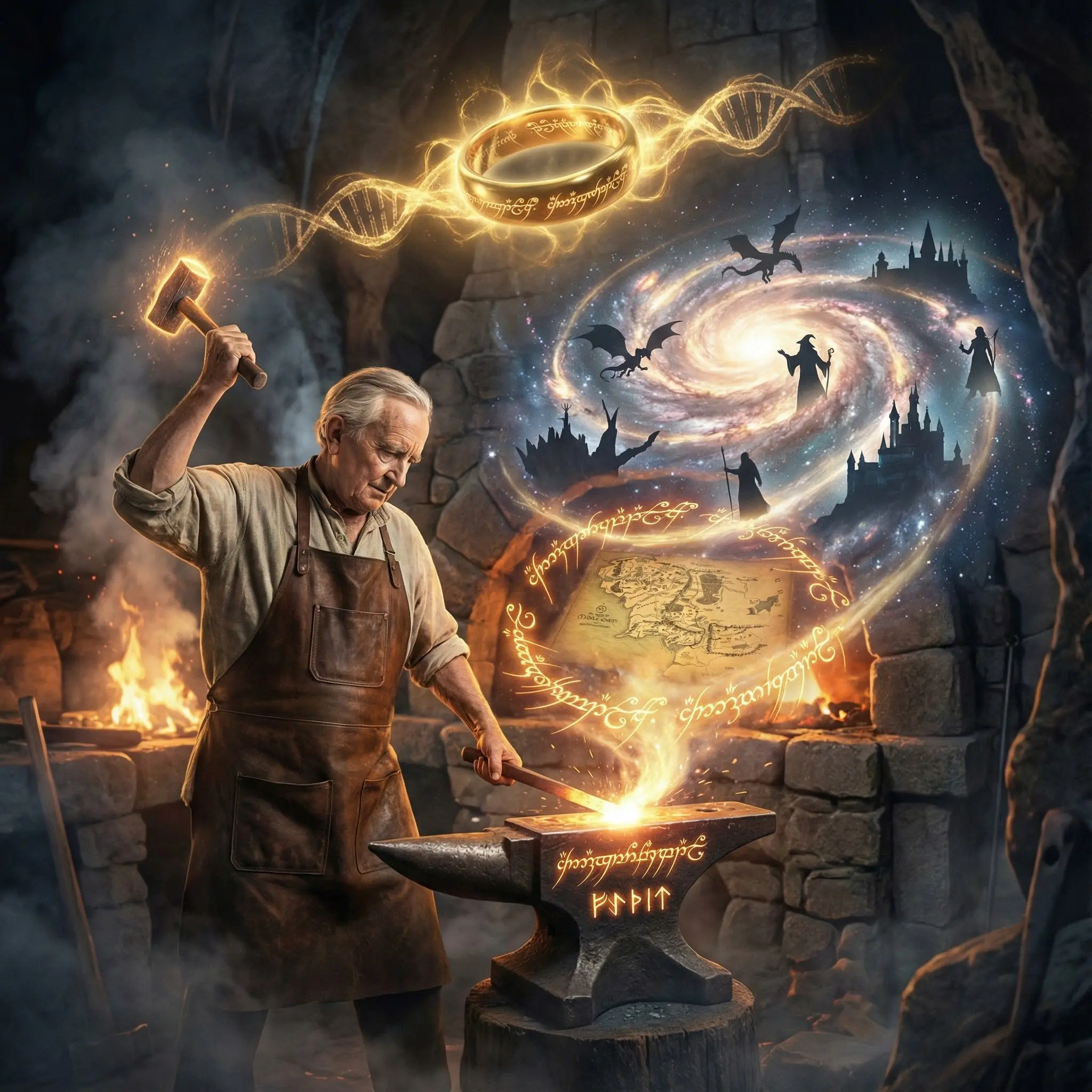

Before Hogwarts, Before Westeros, There Was Middle-earth
I learned English because of comic books, as I said many times, specifically to read Batman. My vocabulary was basically “justice,” “vigilante,” and “Batarang.” But it was Tolkien’s Lord of the Rings that taught me how to fall in love with entire worlds. This is my Lord Of The Rings Guide to the one saga that rules them all.
First came Middle-earth before Hogwarts magic. Then Westeros bled across our screens. Elves had cheekbones sharp enough to cut glass on Netflix after that. J.R.R. Tolkien didn’t just change fantasy storytelling. He chiseled its bones. He breathed fire into its lungs. He made it walk barefoot across Mordor carrying the weight of modern myth.
We are discussing the literary titan whose imagination gave us the concept of orcs. He also created the modern epic trilogy structure. Peter Jackson took a bold risk in the early 2000s with a film adaptation. This project easily could’ve crashed into cinematic obscurity, but we got magic instead. Real magic. The magic that won 17 Oscars. It spawned a fandom that’s been humming the Shire’s theme in its sleep ever since.
This is your complete Lord of the Rings guide. Whether you’re a first-timer or a lifelong Frodo fan, buckle your elven cloak—we’re going there and back again.

Tolkien Wasn’t Just Writing: He Was World-Building Like a Mad Genius
J.R.R. Tolkien wasn’t your average author. This guy was a philologist. That’s a fancy word for someone who studied languages like they were collectible cards. He created entire languages before writing the stories to go with them. Quenya and Sindarin (that’s Elvish to you and me) weren’t just sprinkled in for fantasy flair. They were the beating heart of his world-building.

Tolkien was also a WWI veteran, and you can feel the weight of war and loss pulsing through every page. Mordor isn’t some abstract evil—it’s a charred reflection of trench warfare and industrial annihilation. Middle-earth isn’t escapism; it’s a mirror, a myth, and a roadmap of human resilience when everything goes to hell.
The man spent decades crafting histories, genealogies, and even songs for cultures that existed only in his mind. Most authors create characters. Tolkien created civilizations. That’s not just impressive—it’s borderline obsessive in the best possible way.
The Literary Bromance That Changed Everything
Tolkien’s friendship with C.S. Lewis—yes, the Chronicles of Narnia guy—was legendary. Both were part of the Inklings. It was an Oxford writing group. They basically invented the idea of nerds passionately arguing over fantasy canon in pubs.

Their relationship wasn’t all lembas bread and roses, though. Tolkien wasn’t a fan of allegory. Lewis loved it. Lewis wasn’t exactly shy about publishing quickly. Tolkien took decades to finish anything. Still, it was Lewis who convinced Tolkien that his Middle-earth stories were worth sharing beyond their cozy Oxford sessions.
So next time you watch Frodo cry, thank Aslan too. Without Lewis pushing him, Tolkien might have kept Middle-earth locked in his desk drawer forever.
The Plot: More Than Just a Really Long Walk
You know the basic drill: magical ring, dark lord, mismatched group of heroes, and an extremely long walk. But The Lord of the Rings isn’t just about destroying the One Ring. It’s about friendship, corruption, and sacrifice. It’s also about the impossibly heavy burden of doing the right thing when literally everyone else has given up.
Frodo is the reluctant hero. Gandalf is the wise-but-sassy wizard who’s basically Middle-earth’s worst GPS. Aragorn is the brooding ranger with royal bloodline issues. Legolas is the elf who never skips archery day. Together with dwarves, humans, hobbits, and one very traumatized Gollum, they form the ultimate fantasy fellowship.

Also, before you ask: the Eagles couldn’t just drop them off at Mount Doom. Stop asking. Sauron had flying Nazgûl, the Eagles aren’t invincible, and stealth was literally the only strategy that worked. Moving on.
The genius of Tolkien’s plot isn’t in its complexity—it’s in its simplicity. Good versus evil, friendship conquering darkness, small people doing big things. These are universal themes dressed up in fantasy clothing, which is why the story works across cultures and generations.

The Characters That Made Us Believe in Heroes Again
Samwise Gamgee: The Real MVP
Hot take that’s not really hot anymore: Samwise Gamgee is the actual hero of this story.
Frodo is crumbling under Ring-induced hallucinations and the weight of cosmic responsibility. Meanwhile, Sam is cooking potatoes and fighting giant spiders. He is also literally carrying Frodo up Mount Doom’s slopes. No superpowers. No magic ancestry. Just pure heart, unshakable loyalty, and an absolute belief that “there’s some good in this world… and it’s worth fighting for.”

Sam represents something rare in modern storytelling. He is the ordinary person who becomes extraordinary through simple acts of love. His determination also sets him apart. He’s the friend we all need and the hero we all could be.
Aragorn: The King Who Didn’t Want the Crown
Aragorn’s character arc hits different when you’re older. Young me thought he was just being dramatic about his heritage. Adult me realizes he’s dealing with generational trauma, impostor syndrome, and the terror of living up to impossible expectations.
Viggo Mortensen brought layers to Aragorn that made him more than just “reluctant king #47.” The man who deflects a real knife thrown at him during filming, accidentally kicks an orc helmet and breaks his toe while staying in character, and genuinely embodies the “king who serves” ideal? That’s commitment to the craft.

Gandalf: The Wise Mentor Who Actually Gets Things Done
Unlike most fantasy mentors who mysteriously disappear when things get tough, Gandalf stays involved throughout the story. Sure, he “dies” and comes back even more powerful, but that’s just good storytelling mechanics.

Ian McKellen’s performance made Gandalf both grandfatherly and genuinely intimidating. The scene where he faces down the Balrog? Pure heroic sacrifice. “You shall not pass!” became a cultural touchstone for a reason. It’s the moment when wisdom chooses to stand against pure evil. It does so knowing the cost.

Peter Jackson’s Films: When Adaptation Becomes Art
Peter Jackson’s Lord of the Rings trilogy (2001-2003) wasn’t just good—it was revolutionary. The trilogy was shot entirely in New Zealand’s breathtaking landscapes. It set new standards for practical effects and CGI integration. It also set standards for set design and sheer cinematic ambition.
Seventeen Academy Awards. Over $2.9 billion at the global box office. The director once made movies about zombie lawnmowers. He became the steward of Tolkien’s sacred scrolls. Remarkably, he didn’t mess it up.
The extended editions are basically a religion at this point. The behind-the-scenes features? A masterclass in filmmaking, friendship, and the kind of collaborative passion that creates genuine movie magic. Howard Shore’s soundtrack still makes our eyes sweat twelve years later.
What Jackson Got Right
Jackson understood something crucial: you can’t film every page of Tolkien’s books without losing your audience. Instead, he captured the spirit of Middle-earth while making necessary changes for cinema. Tom Bombadil got cut. Sorry, Tom. However, we gained Arwen’s expanded role. There are also some genuinely emotional moments that weren’t in the books.

The practical effects aged better than most CGI from the same era. Jackson’s team built real locations and forged actual weapons. They created prosthetics that actors could interact with naturally. Gollum was groundbreaking CGI, but he felt real because Andy Serkis performed every scene.

Jackson also understood that epic fantasy works best when it’s grounded in genuine emotion. The friendship between Frodo and Sam, Aragorn’s self-doubt, Boromir’s redemption—these human moments make the epic scope feel personal.
How Tolkien Changed Fantasy Forever
Tolkien gave fantasy literature its spine. Without Middle-earth, there’s no Game of Thrones, no Witcher, no Elden Ring. Every modern fantasy world borrows something from Tolkien. It could be races like elves, dwarves, or orcs. It might be narrative structures like the hero’s journey. Or it could just be general vibes like gray cloaks, ancient prophecies, and moody kings with daddy issues.

The sheer scale of Tolkien’s world-building was immense. He created detailed maps and complete languages. Thousands of years of history were crafted, along with songs that actually scan properly. These elements made him not just a storyteller but a cultural architect. Fantasy before Tolkien was fairy tales. After Tolkien? It became legend.

The Ripple Effect Across Media
Video games owe everything to Tolkien. D&D literally licensed Middle-earth concepts before creating their own versions. Every massively multiplayer online role-playing game (MMORPG) with different fantasy races follows the template Tolkien established. Every RPG with detailed lore does as well. Every fantasy game with epic quests is doing the same.

Modern superhero storytelling learned from Tolkien’s approach to ensemble casts. It also drew inspiration from his techniques in world-building. Additionally, the concept that personal stakes can have cosmic consequences was adapted. The Avengers assembly moment? That’s Fellowship energy applied to a different genre.
Your Lord of the Rings Guide: Where to Start
For Complete Newcomers
Do yourself a favor: watch Peter Jackson’s movies first. Start with The Fellowship of the Ring, move through The Two Towers, and finish with Return of the King. Extended editions if you’re feeling brave and have snacks prepared.

The films serve as a perfect introduction. They capture Tolkien’s essential themes. The visuals are spectacular enough to hook modern audiences. You’ll understand why people get emotional about fictional hobbits, and that’s the gateway drug to deeper Tolkien appreciation.
Reading the Books: What to Expect
Then read the books (I included “The Hobbit” in the link as well). Yes, some people might think they are dense (not for me!). Yes, there’s extensive walking and even more extensive descriptions of landscapes. But once you adjust to Tolkien’s rhythm, it’s like sinking into ancient magic.
Tolkien writes like someone telling stories around a campfire—there’s a timeless, oral tradition quality that modern fantasy often lacks. Don’t rush it. Let yourself get lost in the language and the world.

Deep Lore for the Obsessed
Ready for the deep end? The Silmarillion contains lore that makes your brain melt in the most amazing way. Elvish feuds spanning millennia, god-tier beings creating the world, and enough backstory to make Marvel’s cosmic timeline look simple.

The Hobbit works perfectly as either a prequel or a starting point. It’s lighter in tone but introduces Middle-earth’s essential elements without the epic weight of the Ring quest.

Lord of The Rings is still redefining Fantasy
At the end of the day, The Lord of the Rings endures because it taps into something primal. It explores the fear of losing what we love. It also highlights the hope that even in absolute darkness, someone will stand against evil.
It reminds us that courage isn’t loud or flashy. That power corrupts gradually, then suddenly. That friendship, loyalty, and second breakfasts can literally change the course of the world.
The Lord of the Rings isn’t just fantasy—it’s the foundation of modern myth-making. It proves that invented worlds can feel more real than reality. Made-up languages can carry genuine emotion. Samwise Gamgee deserves a place alongside Superman and Batman in the pantheon of truly great heroes.

The Cultural Legacy
Tolkien created more than entertainment—he created a shared cultural language. When we talk about “epic journeys” or “unlikely heroes,” we’re using concepts Tolkien refined and popularized. When we debate the ethics of power or the cost of victory, we’re having conversations Tolkien started.
The Lord of the Rings taught an entire generation that stories could be more than escapism. These stories could be profound explorations of what it means to be human. They explore what we owe each other and why hope matters even when everything seems lost.

The Final Word: Why This Saga Rules Them All
Tolkien didn’t just write a fantasy series. He created the template for how we tell epic stories about good and evil. These stories also focus on friendship and sacrifice. Jackson didn’t just adapt books—he proved that faithful adaptation could enhance rather than diminish beloved source material.

Together, they gave us something rare: a story that works perfectly as literature, as cinema, and as cultural touchstone. The Lord of the Rings remains the gold standard for fantasy storytelling. It understands that the best adventures are about the journey, not the destination. The greatest victories are won by ordinary people who refuse to give up.
Middle-earth lives in our imagination because Tolkien built it with love, loss, and language. He had an unshakeable belief in the power of stories to make us better than we are. In a world that often feels as dark as Mordor, that’s not just entertainment—it’s hope with a really good soundtrack.
Lord of The Rings and all related characters, names, marks, emblems and images are trademarks of JRR Tolkien and Warner Bros. This content is transformative commentary and review material created by Fandoria and is not affiliated with or endorsed by the companies mentioned.
For more Universe mythology deep-dives, explore our stories about:


Leave a Reply