


When Simplicity Becomes Complexity
Minecraft isn’t just a game, it’s a digital generation’s defining experience. The Minecraft Lore shows: Over 300 million copies sold, countless hours logged, and an influence that shaped YouTube culture and how we think about creative freedom in gaming.
Yet here’s what most people miss: beneath those blocky graphics and seemingly random world generation lies actual mythology. Environmental storytelling so subtle that players spent years piecing together fragments of a civilization that vanished before you ever punched your first tree.

The beauty of Minecraft lore isn’t that it’s hidden—it’s that the game respects your intelligence enough to let you discover it yourself. No cutscenes explaining everything, no quest markers pointing you toward meaning. Just ruins, strange mobs, and dimensions that raise more questions than answers.
This complete guide breaks down the Minecraft lore that most players miss, exploring why a game about placing blocks became gaming’s most enduring phenomenon.
What Makes Minecraft Work
At surface level, Minecraft functions as a sandbox survival game. Punch trees, craft tools, build shelters, fight hostile mobs. Standard gaming loop that’s been done before and since.
What separates Minecraft is scope. The game offers two primary modes that represent completely different philosophies about play:
Survival mode tests resourcefulness and creativity under pressure. Every decision matters when night falls and zombies spawn. Managing inventory, finding food, establishing safe zones—this mode creates genuine tension from simple mechanics.

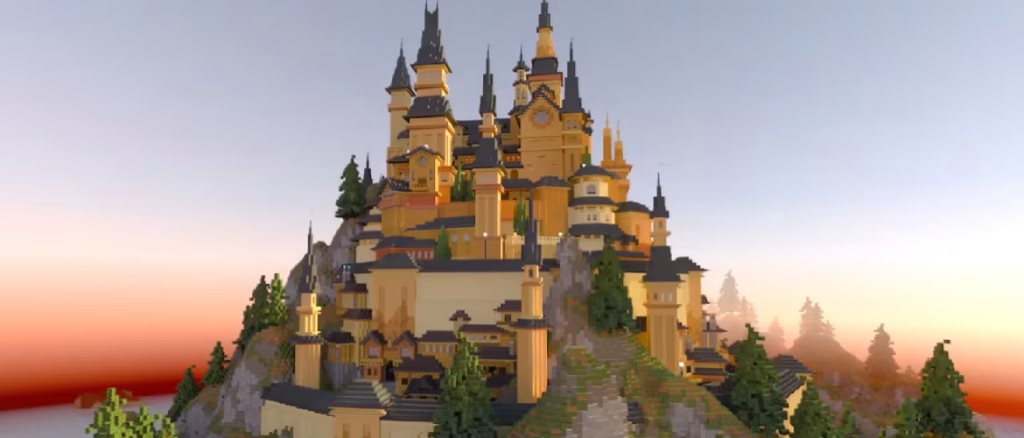
Creative mode removes all constraints, giving players unlimited resources and flight. Entire communities built faithful recreations of Hogwarts, Middle-earth, functioning computers, and art installations that would make modern architects jealous.

Beyond these core modes, the game includes Hardcore (permadeath), Adventure (custom maps with restrictions), and Spectator options that spawned entire genres of content. Role-playing servers, horror maps, puzzle adventures, competitive minigames—all built within Minecraft’s flexible framework.
The genius lies in making depth optional. Casual players can build cozy cottages and tend farms. Hardcore enthusiasts can speedrun the Ender Dragon in under 20 minutes. Both experiences are equally valid because the game never tells you which matters more.
The Hidden Story Nobody Talks About
Here’s where understanding Minecraft lore gets interesting: the game has actual mythology, but you’ll never find it in a codex or tutorial. Environmental storytelling reveals fragments of a narrative that players piece together like archaeological evidence.
The Three Dimensions
The Overworld represents your starting point—lush biomes, random generation, and semi-hostile environments where zombies and skeletons spawn at night. Surface-level gameplay suggests simple survival mechanics, but structures scattered throughout hint at something deeper.

The Nether functions as an underworld dimension accessed through obsidian portals. Lava oceans, hostile mobs, and Piglins living in Bastion Remnants suggest civilizations that adapted to hellish conditions. Ancient debris and netherite hint at advanced technology from builders who understood this dimension’s properties.

The End serves as the game’s dimensional endgame—void islands floating in darkness, ruled by the Ender Dragon and inhabited exclusively by Endermen. End cities contain valuable loot but feel abandoned, like remnants of something that left or died out.

The Ancient Builder Theory
Fan theories (tacitly supported by environmental evidence) suggest players aren’t starting fresh—they’re rediscovering a world that advanced civilizations already abandoned.
Consider the evidence scattered throughout the Minecraft lore:
Strongholds buried underground contain libraries, prisons, and End Portals. Someone built these fortress-temples, then left them to decay. The portal frames suggest knowledge of dimensional travel existed before you arrived.

Ocean monuments house hostile Guardians protecting… nothing. These structures imply underwater civilizations that either evolved or died out, leaving only aggressive defenders of empty halls.
Desert and jungle temples contain traps and treasure, suggesting cultures that valued protecting their resources even after death. The sophistication of redstone mechanisms indicates advanced engineering.
Villages populated by Villagers who can’t speak and only trade. Are they descendants of builders, devolved after some catastrophe? Their simple existence contrasts sharply with the complex structures around them.
Nether fortresses and Bastions prove civilizations existed in hostile dimensions. Someone not only survived the Nether but thrived enough to build permanent structures and develop complex societies.

The Endermen Connection
The most compelling aspect of Minecraft lore involves Endermen—tall, dark figures that teleport, speak reversed English, and attack when you make eye contact. Their behavior suggests intelligence rather than simple hostility.

Endermen carry blocks, as if trying to remember building. They take damage from water, like creatures adapted to dry dimensions. They inhabit The End naturally but also spawn in the Overworld and Nether, as if they once belonged everywhere.

The theory: Endermen are what ancient builders became—transformed by dimensional travel or evolution into creatures that can only watch the worlds they once created.
From Indie Experiment to Cultural Phenomenon
Understanding Minecraft lore means understanding its journey from obscure indie game to generational touchstone. Markus “Notch” Persson released the first public version in 2009, building on ideas from Infiniminer and his own creative vision.
The game grew through word of mouth and YouTube culture. Let’s Play videos introduced millions to Minecraft’s possibilities, creating a feedback loop where content creators showcased builds, mods, and adventures that inspired players to create their own.

YouTube’s First Gaming God
Minecraft didn’t just benefit from YouTube—it helped define modern gaming content. Creators like CaptainSparklez, DanTDM, and later Dream built massive audiences through Minecraft videos. The game’s visual simplicity and creative depth made it perfect for streaming and recording.
Let’s Play culture as we know it today owes much to Minecraft’s rise. The game proved that watching other people play could be entertaining when the gameplay encouraged creativity and personality.
Educational Revolution
Schools adopted [Minecraft: Education Edition] to teach subjects ranging from coding to history. Students built historical landmarks, programmed redstone circuits that taught logic gates, and collaborated on projects that developed social skills.
The game’s flexibility allowed teachers to create lesson plans around geology (mining and ore distribution), architecture (historical building styles), and even literature (recreating settings from books). Suddenly, a “video game” became a legitimate educational tool accepted by administrators who’d never played games themselves.

Speedrunning and Competitive Play
The game’s open-ended nature didn’t stop competitive communities from forming. Speedrunners optimized every aspect of reaching the End and defeating the Ender Dragon, developing strategies that shaved seconds through precise execution.

Random seed runners tackle whatever world they’re given, demonstrating mastery of game mechanics rather than memorized routes. Set seed runners perfect specific worlds, competing for frame-perfect execution.
The technical skill involved in high-level Minecraft speedrunning rivals any esports game, just without the corporate infrastructure or massive prize pools.

Microsoft’s Acquisition: A Surprise Success Story
When Microsoft purchased Mojang for $2.5 billion in 2014, fans worried about corporate interference destroying what made Minecraft special. The gaming industry had seen acquisitions kill beloved properties before.
Surprisingly, Microsoft mostly maintained hands-off stewardship. The company added cross-platform compatibility (Bedrock Edition), improved mod support, and created spinoffs like [Minecraft Dungeons] (action RPG) and [Minecraft Legends] (strategy game) without fundamentally changing the core experience.
Sure, the Java/Bedrock split creates friction between versions. Yes, the marketplace introduced monetization that feels at odds with Minecraft’s creative freedom. But the game itself remains recognizable, with major updates adding depth rather than fundamentally altering the experience.
Recent updates introduced mechanics like archaeology, copper building blocks, and deep dark biomes that expand rather than replace core gameplay. Microsoft understood what many publishers don’t: sometimes the best thing you can do with an acquisition is leave it mostly alone.

Starting Your Minecraft Journey
New players face a unique challenge: Minecraft offers so much freedom that it’s easy to feel overwhelmed. Here’s the optimal path for understanding both gameplay and Minecraft lore:
Phase 1: Learn Survival Basics Start on Peaceful or Easy difficulty. Learn to gather resources, craft tools, build shelter, and establish food sources. The game teaches through experimentation rather than tutorials, so expect to die learning what works.
Phase 2: Explore and Discover Once you’re comfortable surviving, start exploring. Find villages, temples, and strongholds. Each structure reveals fragments of Minecraft lore while providing resources for your journey.
Phase 3: Dimensional Travel Build a Nether portal using obsidian. The Nether introduces new challenges and resources while deepening the environmental storytelling. Find a fortress, gather blaze rods, and prepare for the final dimension.

Phase 4: The End Locate a stronghold, activate the End Portal, and face the Ender Dragon. This “endgame” content represents the closest thing Minecraft has to a traditional conclusion, though the game continues indefinitely after.
Phase 5: Creative Freedom Switch to Creative mode or start new worlds with specific goals. Build massive projects, experiment with redstone contraptions, or explore mods that add new dimensions to the experience.
Essential Resources
For Learning:
- [Minecraft: The Official Beginner’s Handbook] provides solid foundation knowledge
- YouTube channels like Hermitcraft showcase advanced building and survival techniques
- [Minecraft Wiki] documents every game mechanic, block, and mob comprehensively
For Expanding Your Experience:
- [OptiFine] improves performance and adds visual options
- [Forge] and [Fabric] mod loaders enable custom content
- [CurseForge] hosts thousands of mods ranging from quality-of-life improvements to total conversions
For Deep Dives:
- [MatPat’s Game Theory series] on Minecraft lore connects environmental storytelling elements
- [The Minecraft Survival Guide] by Pixlriffs provides 300+ episodes of tips and techniques

Why Minecraft Endures
Most games have shelf lives measured in months or years. Blockbuster releases dominate conversations briefly, then fade as the next big thing arrives. Minecraft has thrived for over a decade, remaining relevant through constant evolution and community engagement.
The secret lies in respecting player intelligence and creativity. Minecraft never tells you what to do or how to play. The game provides tools and mechanics, then trusts you to do something interesting.

This philosophy creates ownership. Your Minecraft world feels genuinely yours because you shaped it through choices that mattered. The dirt house you built on night one holds emotional weight because you created it under pressure, not because a quest marker told you to.
Minecraft lore enhances rather than constrains this freedom. The environmental storytelling rewards curiosity without requiring engagement. Casual players can ignore dimensional travel entirely, while lore enthusiasts can spend hours theorizing about ancient builders and Endermen.
The Legacy That Keeps Building
Minecraft transformed gaming culture in ways still unfolding. The game proved that graphics aren’t destiny, that player creativity trumps scripted content, and that educational value can coexist with entertainment.
Content creation changed because Minecraft demonstrated that watching others play could be as engaging as playing yourself, especially when personality and creativity drove the content.
Game development shifted as studios realized that giving players tools to create often beats trying to anticipate what they want to consume.
Education evolved when administrators saw students genuinely excited about learning subjects through block-based gameplay.
The best-selling game of all time isn’t a photorealistic shooter or story-driven adventure—it’s a blocky sandbox that trusts players to make their own fun. That alone tells you something important about what actually matters in game design.

The Real Story Behind the Blocks
Minecraft lore ultimately reveals a game that respects mystery. Not everything needs explanation or resolution. Sometimes the most powerful stories are the ones we piece together ourselves from fragments and implications.
Those Endermen staring from the darkness, those ruined portals in random locations, those empty monuments guarded by hostile creatures—they’re all questions waiting for your interpretation. The game never confirms theories because the ambiguity is the point.
In a gaming landscape obsessed with explaining everything through cutscenes and codex entries, Minecraft suggests that maybe the best stories are the ones that trust you to figure it out. The ancient builders vanished for reasons you’ll never know for certain, and that’s perfectly fine.
Your job isn’t to uncover what happened to them. Your job is to build something worth discovering for whoever comes after you. Maybe that’s the actual Minecraft lore—that civilizations rise, fall, and leave behind mysteries for the next generation to puzzle over.
Or maybe you’re just here to build a cool castle and fight skeletons. Both are valid. That’s the magic.
For more gaming mythology deep-dives, explore Why Fortnite’s storytelling shouldn’t work but does!


Leave a Reply