
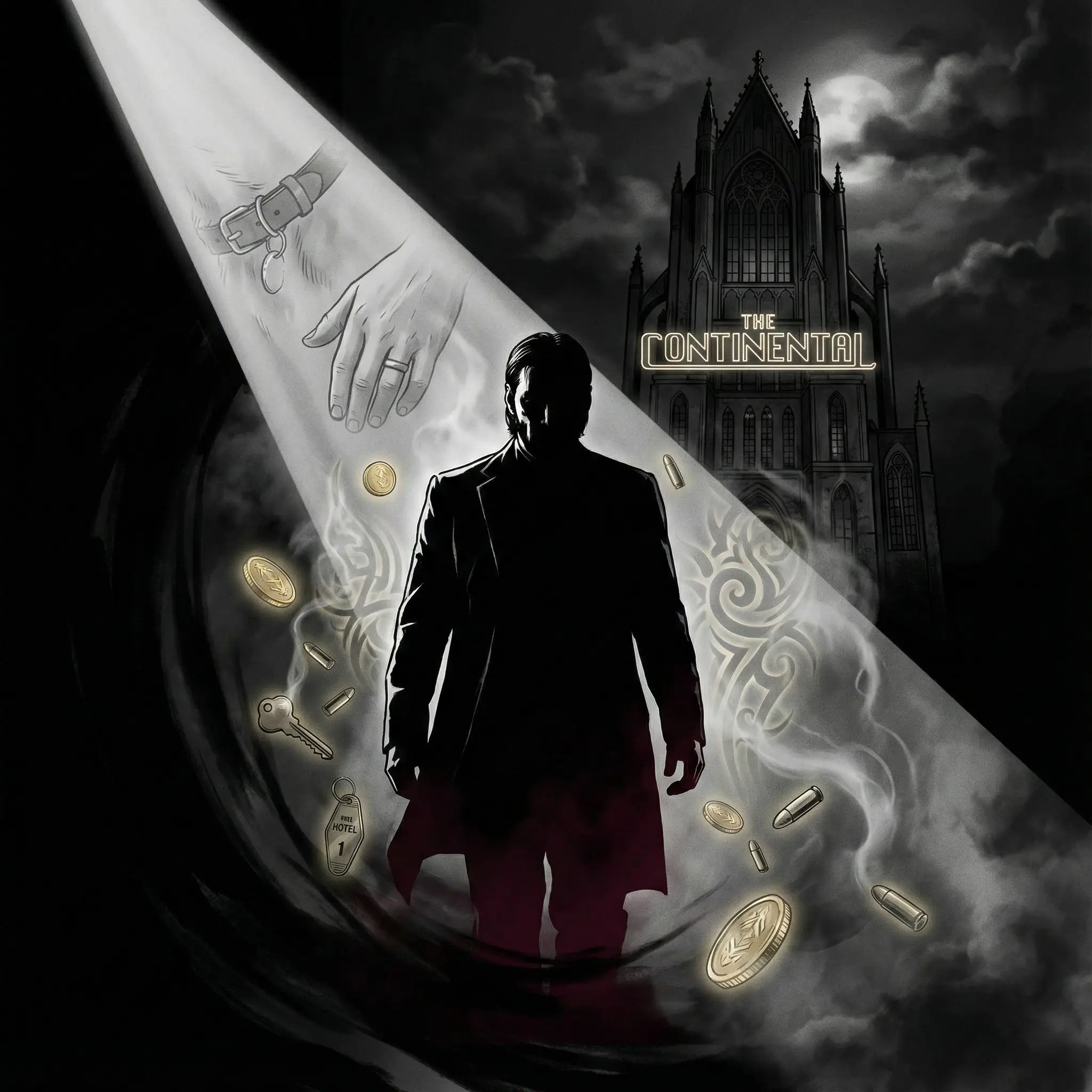

How One Dog Changed Action Cinema Forever
Cutting through the hype: John Wick didn’t reinvent the action wheel. But the John Wick Mythology did…it just polished action to perfection and added a pencil. The story started as a straightforward revenge story about a grieving widower and his murdered puppy. But It has become the most meticulously crafted action mythology since The Matrix.
The John Wick mythology isn’t just about cool fight scenes (though they’re incredible). It’s about how directors Chad Stahelski and David Leitch built an entire criminal ecosystem with more internal logic than most governments. Every gold coin, every tattoo, and every Continental rule serves the story. These elements expand a world that feels lived-in rather than manufactured for sequels.

Four films later, we’ve got a universe spanning continents, centuries of history, and enough stylized violence to make Quentin Tarantino jealous. But what makes this mythology work when so many action franchises collapse under their own weight?
Simple: John Wick world building comes down to one thing—consequences. Every action has a reaction, every favor demands payment, and every rule broken makes the next movie’s stakes higher. It’s action filmmaking with actual math behind it.

The Legend Behind the Name
Before diving into hotels and gold coins, let’s understand the John Wick mythology from the beginning. The protagonist isn’t just “John Wick”—he’s Jardani Jovonovich, born into the Ruska Roma crime family and trained from childhood to be death in a tailored suit.
The name “Baba Yaga” gets thrown around a lot. Here’s the thing most people miss: In Slavic folklore, Baba Yaga isn’t just a “monster”. She’s a supernatural force of nature who can be helpful or destructive depending on how you approach her. Sound familiar? John Wick helps those who follow the rules and destroys those who don’t.

Viggo Tarasov explains it best in the first film: John Wick isn’t the boogeyman—he’s the one you send to kill the it. That’s not just a cool line; it’s the entire franchise’s mission statement. Understanding John Wick mythology means grasping that he’s so good at something that he transcends normal human categories.

The Impossible Task
The cornerstone of John Wick mythology revolves around his “impossible task”—the job he completed to earn his freedom from Viggo Tarasov. We never see it happen, but the aftermath defines everything. Wick killed enough people in a single night to cripple the Russian mob’s New York operations permanently.
This backstory accomplishes something brilliant: it establishes John as legendary without showing us the legend. We have to take everyone’s word for how terrifying he is, which makes his reluctant return to violence hit harder. The man who walked away from being a killing machine gets dragged back because some punk kid killed his dog.

The Continental: Where Killers Go to Chill
The Continental Hotel system is where John Wick lore gets really interesting. On the surface, it’s a chain of luxury hotels. Dig deeper, and it’s a global network of neutral territory for the world’s most dangerous people.

The rules are deceptively simple:
- No business on Continental grounds
- Every service costs one gold coin
- The manager’s word is law
But the execution is what makes it brilliant. The Continental isn’t just a hotel—it’s a combination embassy, bank, employment office, and sanctuary all rolled into one. Need weapons? Visit the sommelier. Need medical attention? The doctor’s on call. Need to disappear? There’s a service for that too.

Winston and the Art of Neutral Authority
Ian McShane’s Winston runs the New York Continental with the perfect balance of charm and menace. He’s genuinely fond of John, but never lets personal feelings override business. Winston’s character shows how power works in this world—through respect, not fear.
Winston’s eventual betrayal and redemption arc across the sequels demonstrates something crucial: even friendship has rules in this universe. When the High Table demands John’s death, Winston follows protocol. When they threaten his hotel, he breaks it. Character development through institutional politics—it’s more sophisticated than most action franchises attempt.

The Gold Coin Economy
The gold coin system is pure genius disguised as simple world-building. Instead of boring exposition about assassin economics, we get a visual shorthand that immediately communicates value and exclusivity. One coin doesn’t equal one dollar—it equals one service, regardless of complexity.
This creates interesting dramatic possibilities. Paying for a taxi ride costs the same as hiding a body. The system values access over expense, which makes the world feel exclusive rather than expensive. You can’t just buy your way in—you have to be part of the club.

The High Table: Corporate Structure for Chaos
The High Table represents the most interesting aspect of the John Wick mythology. It poses the question: how do you govern chaos without destroying it? Instead of making the criminal underworld anarchic, the films present it as hyper-organized, with the High Table functioning as a shadowy board of directors.
Each seat on the High Table represents a different crime family or syndicate. The Italian Camorra, Russian Bratva, Chinese Triads—they all answer to this council. It’s organized crime taken to its logical extreme: bureaucracy with bullets.

The Adjudicator and Divine Justice
The Adjudicator character in Chapter 3 embodies how the High Table enforces order. They’re not cruel or sadistic—they’re methodical. Rules exist, and breaking them has consequences. The bureaucratic approach to violence shown through the Adjudicator creates unique dramatic tension.
This bureaucratic approach to violence creates unique dramatic tension. John isn’t fighting cackling villains—he’s fighting middle management with unlimited resources. It’s scarier because it feels realistic. Anyone who’s dealt with corporate HR will recognize the Adjudicator’s approach.

Global Expansion: A World of Professional Killers
The later films expand the John Wick mythology beyond New York, revealing a worldwide network of assassins with local flavors. The Osaka Continental feels distinctly Japanese, with samurai-influenced customs and aesthetic. Casablanca’s desert operations have different rules and traditions.
This isn’t just location tourism—it’s cultural world-building. Each Continental reflects its environment while maintaining core principles. The global approach shows how ancient traditions adapt to modern criminal enterprises.

The Bowery King and Street Level Operations
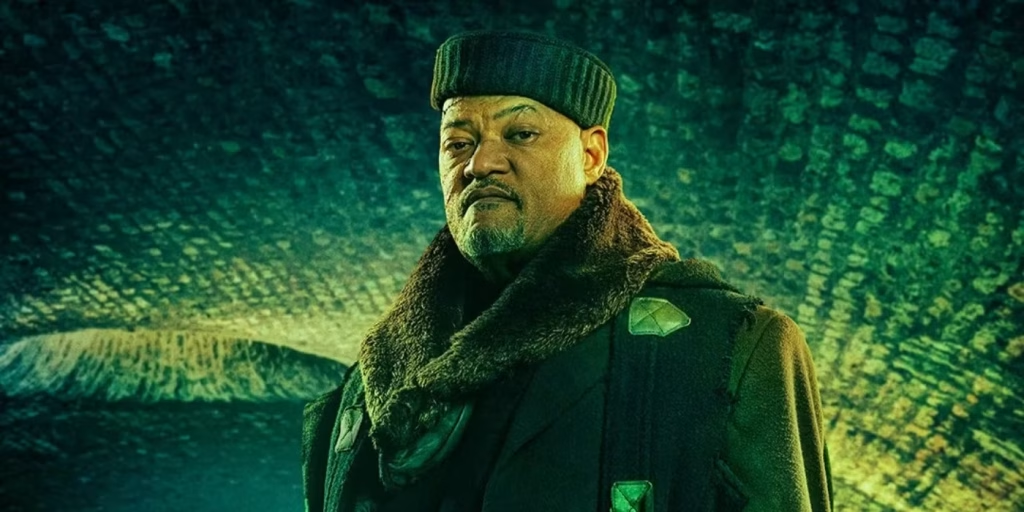
Laurence Fishburne’s Bowery King represents the franchise’s most interesting addition: how does this organized criminal world interact with street-level crime? His network of homeless informants operates parallel to the Continental system, showing that even criminals have class divisions.
The dynamic between the Bowery King and John reveals something crucial about power structures. The King has resources and information, but he still defers to John’s reputation. Respect trumps authority in this world, which is why the Baba Yaga legend matters more than any title.
The Action That Serves the Story
Here’s where the John Wick mythology gets technical: every fight scene advances the plot or develops character. The pencil kill in the first film establishes John’s improvisation skills. The museum fight in Chapter 2 shows how violence follows him even into high culture. The horse chase in Chapter 3 demonstrates his adaptability.
Compare this to most action franchises, where fight scenes exist to fill time between plot points. The John Wick films use violence as narrative language. Each kill count escalation serves the story’s themes about consequences and escalation.

The Stunt Team as Storytellers
Chad Stahelski’s background as a stunt coordinator shows in every frame. The action choreography tells stories that dialogue doesn’t need to explain. John’s fighting style changes based on his emotional state—methodical when calm, desperate when cornered, brutal when angry.
The John Wick films use violence as narrative language. Each kill count escalation serves the story’s themes about consequences and escalation. We understand John’s mental state by watching how he fights. It’s visual storytelling at its most effective.

Why the Mythology Works
Most action franchises collapse when they try to expand their worlds. Fast & Furious jumped the shark somewhere between street racing and space missions. Mission: Impossible works because it stays focused on Tom Cruise doing impossible things. The John Wick lore succeeds because it maintains internal consistency while escalating stakes.
The key insight: the world was always this big and organized. We’re just seeing more of it as John’s actions force him deeper into the system he tried to leave. Nothing feels retrofitted or manufactured for sequels—it all flows from the original premise.
Character-Driven Universe Expansion
Every new element—from gold coins to the High Table—reinforces the central themes of consequence and honor. It’s world-building with purpose rather than profit.
The best part? Audiences appreciate intelligence in their action films. The detailed mythology rewards attention and analysis, creating a fandom that dissects tattoo meanings and debates Continental protocols. When you respect your audience’s intelligence, they’ll invest deeper in your world.

Extended Universe Excellence
Unlike most franchises that feel desperate to expand, John Wick spinoffs actually enhance the main story. “The Continental” series explores the hotel’s origins without contradicting established canon. “Ballerina” will presumably show another corner of this world without requiring John Wick himself.

Why does this work? The world was built to accommodate multiple stories from the beginning. John Wick is the most famous assassin, not the only one. The mythology can support various characters because it was designed with that scope in mind.

Comics and Expanded Media
The John Wick comics from Dynamite Entertainment fill in backstory without feeling mandatory. They’re Easter eggs for fans rather than required reading. This restraint shows creative maturity—not everything needs explanation.


What Makes It Work When Others Fail
Most action franchises fail because they confuse bigger with better. The John Wick mythology succeeds because it confuses better with smarter. The action gets more elaborate, but it also gets more personal. The world gets bigger, but the stakes remain character-driven. In a world where violence solves everything, having consistent rules creates dramatic tension. We know what breaking those rules costs, which makes every transgression meaningful.
The Anti-Marvel Approach
While Marvel creates mythology through exposition and MacGuffins, the John Wick mythology creates itself through behavior and consequences. We learn the rules by watching characters follow or break them. The world builds itself through character actions rather than explaining itself through dialogue.
This show-don’t-tell approach creates more immersive world-building. The organic mythology feels natural because it emerges from story needs rather than franchise requirements.

Your Complete Viewing Guide
If you’re diving into the John Wick mythology for the first time, here’s the optimal approach:
Essential Viewing:
- John Wick (2014) – The perfect introduction to the world and rules
- John Wick: Chapter 2 (2017) – Expands the mythology without losing focus
- John Wick: Chapter 3 – Parabellum (2019) – Shows the consequences of breaking rules
John Wick: Chapter 4 (2023) – Brings the story full circle
Extended Universe:
- The Continental (series) – Origins of the New York hotel in the 1970s
- Ballerina – Ana de Armas in the same universe
- Comics – Background on John’s early career and training
Pro Tips:
- Pay attention to the background details—every tattoo, coin, and gesture means something
- Notice how the action choreography reflects character emotional states
- Watch for the escalating consequences of each film’s rule-breaking
The John Wick Mythology
In an era of CGI spectacle and universe-building, John Wick’s mythology stands out. It shows that world-building works best when it serves character and story. The elaborate criminal ecosystem never overshadows the simple emotional core. It is about a man who lost everything. He got pulled back into the life he tried to leave.
The John Wick mythology demonstrates how to expand a story without losing its soul. Every new element—from gold coins to the High Table—reinforces the central themes of consequence and honor. It’s world-building with purpose rather than world-building for profit.

Most importantly, it shows that audiences appreciate intelligence in their action films. The detailed mythology rewards attention and analysis, creating a fandom that dissects tattoo meanings and debates Continental protocols. When you respect your audience’s intelligence, they’ll invest deeper in your world.
John Wick is proof that action movies can be smart, stylish, and emotionally resonant all at once. In a genre often dismissed as mindless, the John Wick mythology stands as evidence that better writing makes better movies. Even when those movies involve killing dozens of people with office supplies.
John Wick and all related characters, names, marks, emblems and images are trademarks of Lionsgate, Dynamite Entertainment and NBC. This content is transformative commentary and review material created by Fandoria and is not affiliated with or endorsed by the companies mentioned.
For more Universe mythology deep-dives, explore our stories about:


Leave a Reply