
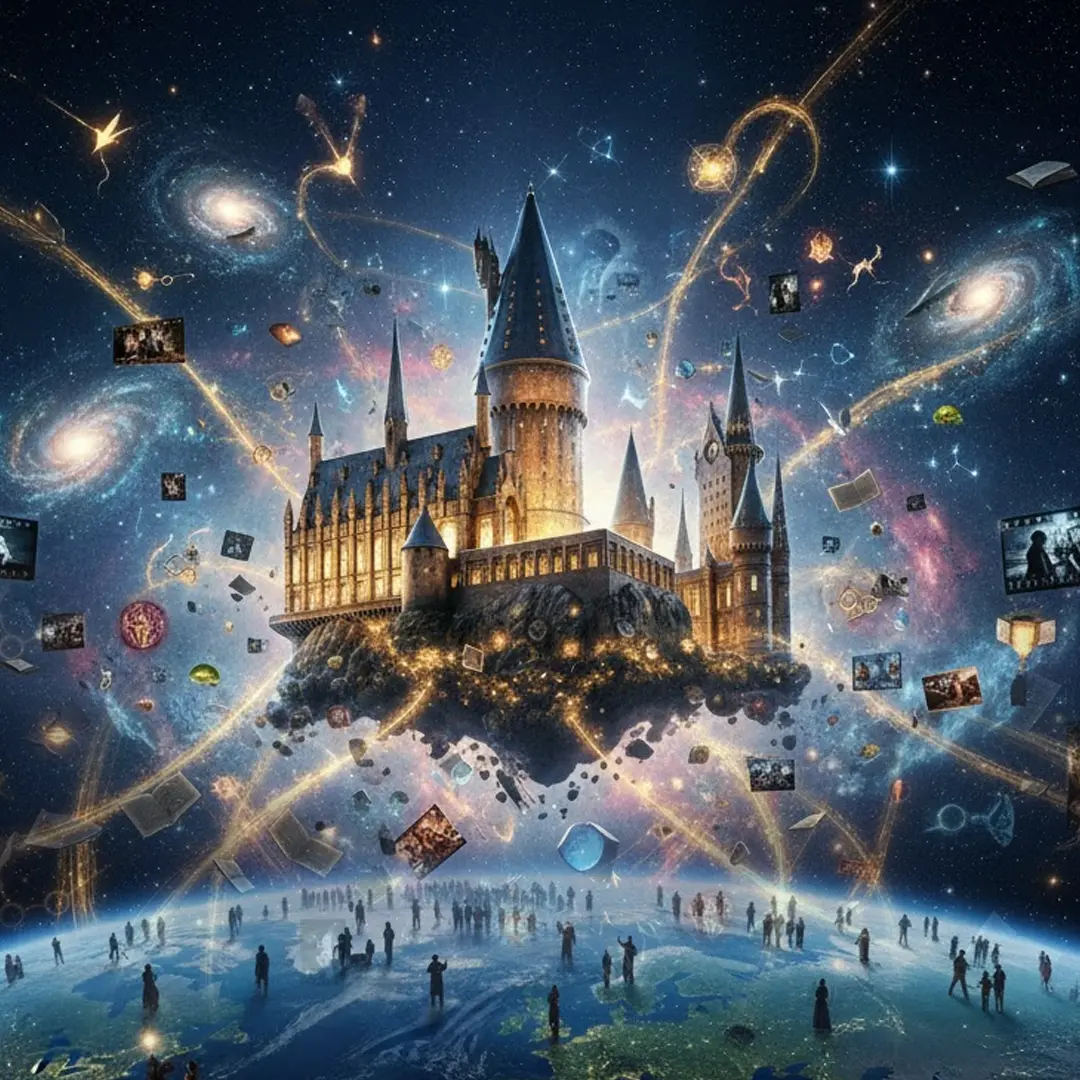

When Stories Become Shelter
Some fandoms flicker out after their initial spark fades. Others burn eternal, phoenix-like, transforming through each generation that discovers them. The Harry Potter universe belongs firmly in the second category.
Whether you first encountered The Boy Who Lived through a midnight book release, the soaring notes of John Williams’ score, or a Sorting Hat quiz that somehow knew you better than you knew yourself, chances are Hogwarts found you. Now, decades later, with theme parks spanning continents, theatrical productions, and fan theories more detailed than most academic dissertations, the wizarding world shows no signs of dimming.
Beyond the nostalgia lies something more substantial—a universe that shaped how an entire generation thinks about courage, identity, and belonging. The Harry Potter universe wasn’t just about spells and wands. It explored prejudice disguised as tradition, the seductive comfort of authoritarianism, and the revolutionary act of choosing love when power seems easier.

This guide explores the lore, magic systems, and cultural mythology that transformed seven books into a modern legend.
The Foundation of Magic
J.K. Rowling’s Harry Potter series spans seven novels published between 1997 and 2007, eight blockbuster films released from 2001 to 2011, and an expanded universe that continues growing through stage plays, spin-off films, and interactive experiences.
At the narrative center stands Harry Potter, a boy raised by hostile relatives who discovers on his eleventh birthday that he’s not just a wizard—he’s famous throughout a magical world he never knew existed. His parents died protecting him from Lord Voldemort, the darkest wizard of the age, and somehow baby Harry survived a killing curse that should have been absolute.

But reducing the Harry Potter universe to one boy’s journey misses the intricate world-building that makes this mythology work. Rowling constructed a magical society existing parallel to our own, complete with its own government (Ministry of Magic), economy (Gringotts Wizarding Bank), education system (Hogwarts and other magical schools), and deeply ingrained prejudices.

The genius lies in making magic feel systematic rather than arbitrary. Potions require precise ingredients and timing. Spells demand proper pronunciation and wand movement. Magical contracts bind participants to their word. Even time travel follows rules that create consequences rather than easy solutions.
The Seven-Year Journey
The Harry Potter universe unfolds across Harry’s seven years at Hogwarts School of Witchcraft and Wizardry, with each book covering one academic year and escalating the stakes:
Year One (Philosopher’s Stone): Harry discovers his identity and finds his first real home among friends and mentors who see him as more than “the boy who lived.”
Year Two (Chamber of Secrets): The school faces an ancient threat connected to Hogwarts’ founding, introducing themes about blood purity and inherited prejudice.
Year Three (Prisoner of Azkaban): Harry learns that truth is more complicated than he believed, discovering that the adults he trusted kept painful secrets.
Year Four (Goblet of Fire): Voldemort returns to physical form, ending any illusion that childhood and safety would last forever.
Year Five (Order of the Phoenix): The Ministry of Magic denies Voldemort’s return, showing how institutions fail when comfort matters more than truth.
Year Six (Half-Blood Prince): Harry learns about Horcruxes—dark objects containing fragments of soul—and begins understanding the true nature of his connection to Voldemort.
Year Seven (Deathly Hallows): The war reaches its conclusion as Harry, Ron, and Hermione hunt Horcruxes while Voldemort consolidates power over magical Britain.
The progression mirrors both traditional coming-of-age narratives and the loss of innocence that defines adolescence. Early books feature childish threats and magical wonder. Later installments confront death, torture, and moral complexity without easy answers.

Why the Lore Resonates Across Cultures
The Harry Potter universe works as modern mythology because its themes translate across cultural boundaries while remaining specific enough to feel authentic.
Magic as Metaphor for Difference
The central conceit—that some people possess abilities others don’t, making them simultaneously special and targeted—resonates with anyone who’s felt different. LGBTQ+ readers saw themselves in characters hiding fundamental aspects of their identity. Neurodivergent fans recognized the struggle to navigate a world with different rules. Children of immigrants understood living between two worlds that never quite connected.
The metaphor remains flexible enough that diverse audiences found personal meaning without the text dictating a single interpretation.

Fascism Wearing Familiar Faces
From Dolores Umbridge’s authoritarian control disguised as educational reform to Voldemort’s pure-blood ideology justifying violence against “mud-bloods,” the series explores how fascism spreads through seemingly reasonable steps.
Umbridge represents institutional evil more effectively than Voldemort’s obvious villainy. She uses bureaucracy, propaganda, and the appearance of legitimacy to commit cruelty. Watching her torture students with a smile while maintaining she’s enforcing proper discipline hits differently than watching obvious monsters do obvious evil.
The series shows that fighting fascism requires more than defeating the final boss—it demands confronting the systems and attitudes that enabled their rise.

Found Families and Chosen Bonds
Harry’s biological family fails him spectacularly. The Dursleys represent everything wrong with valuing appearance over substance, normalcy over authenticity. In contrast, the Weasleys welcome Harry unconditionally, Hagrid risks his position to protect him, and Hermione’s Muggle-born status makes her an outsider who chooses to fight for the magical world anyway.


The Harry Potter universe consistently reinforces that families you choose often matter more than families you’re assigned. This theme resonates powerfully with queer audiences, children from troubled homes, and anyone who found belonging outside traditional family structures.

Death as the Ultimate Theme
Death permeates every aspect of the Harry Potter universe. The series opens with parent murder and closes with Harry willingly walking to his own death. Between those bookends, the story explores grief, loss, and what we leave behind.
Ghosts haunt Hogwarts (check out why you should never send your kids to this school!) but cannot truly interact with the living. Horcruxes preserve life by fragmenting the soul, creating existence without wholeness. The Resurrection Stone returns the dead but cannot truly restore them. The series insists that death is natural, necessary, and must be accepted rather than defeated.

This philosophical sophistication separates the Harry Potter universe from simpler fantasy where death is just an obstacle to overcome through sufficient power or cleverness.
The Magical Systems That Make It Work
The Harry Potter universe succeeds because its magic follows consistent internal logic while remaining mysterious enough to feel, well, magical.
The House System
Hogwarts divides students into four houses based on their values: Gryffindor (courage), Slytherin (ambition), Ravenclaw (intelligence), Hufflepuff (loyalty). The system seems designed to create lifelong identity and community while also perpetuating prejudice and limiting growth.

Slytherin produces dark wizards not because ambition is inherently evil but because the school treats Slytherin students as future villains, creating a self-fulfilling prophecy. The series gradually reveals how arbitrary categories become destiny when institutions treat them as immutable.

Magical Objects and Their Rules
The Harry Potter universe contains numerous powerful objects, each with specific limitations.

The Elder Wand passes to whoever defeats its previous master, creating a trail of violence and betrayal. Its power tempts but cannot bring happiness.
The Philosopher’s Stone creates immortality through eternal life, but at the cost of remaining hidden and protected rather than truly living.
Time-Turners allow temporal manipulation within strict limits—you cannot change what’s already happened, only ensure it happens as it always did.

These limitations matter. Magic solves problems but creates new ones. Power comes with consequences. The universe refuses easy answers even when magic theoretically provides them.
Creatures Great and Tragic
Magical creatures in the Harry Potter universe range from majestic (phoenixes, hippogriffs) to misunderstood (house-elves, centaurs) to genuinely terrifying (dementors, basilisks). Many represent themes about how societies treat those they consider lesser.

House-elves serve wizards through magical enslavement that most magical society considers natural and proper. Hermione’s campaign for elf rights faces mockery because challenging systemic oppression makes people uncomfortable.
Dementors feed on happiness, draining joy from everything around them—a perfect metaphor for depression that affects Harry more than most characters because of his traumatic past.

The creatures aren’t just window dressing but integral to exploring how power structures dehumanize and exploit.
The Fandom That Carries the Magic Forward
The Harry Potter universe lives through its community as much as through official content. Fans have created a cultural phenomenon that exists independent of any single creator or corporate entity.
Fan Creation as Cultural Force
Fanfiction exploring characters, relationships, and possibilities the original texts left unexplored numbers in the hundreds of thousands. Entire sub-fandoms exist around the Marauders era, Draco’s redemption, or alternate universes where different choices create different outcomes.
Fan artists reimagine characters across cultures, time periods, and art styles. Podcasts dissect themes, chapters, and character motivations with academic rigor. TikTok creators introduce new generations to the series while adding contemporary perspectives.
This creative energy transforms passive consumption into active participation, ensuring the Harry Potter universe remains vibrant rather than static.

Navigating Complicated Legacy
The series creator’s public statements about gender identity have created painful divisions within the fandom. Many fans who found acceptance and courage through these stories now struggle to reconcile the text’s messages with the author’s positions.
The response has been to claim the magic while rejecting elements that harm. Fans assert that stories, once released into the world, belong to everyone who finds meaning in them. The Harry Potter universe has become larger than any single person, evolving through collective interpretation and reimagination.
This complicated relationship between creation and creator raises questions about art, ownership, and how we engage with culturally significant works made by flawed people.

Starting Your Wizarding Journey
New readers face a fortunate problem: multiple entry points into the Harry Potter universe, each offering different strengths.
The Novels Remain Essential Start with [Harry Potter and the Philosopher’s Stone], reading through the series in publication order. The books provide depth, context, and character development that films necessarily compress or omit.
Rowling’s prose improves across the series, maturing alongside her protagonists. Early books feel appropriately childlike, while later installments tackle complex themes with greater sophistication.
The Films Offer Visual Magic The eight-film series, particularly Alfonso Cuarón’s [Harry Potter and the Prisoner of Azkaban], translates the wizarding world into stunning visuals. The films excel at spectacle and emotional moments while streamlining plot complexity.
Watch after reading for the best experience, though the films stand alone if book commitment feels overwhelming.
Extended Universe Exploration [The Wizarding World website] offers interactive Sorting ceremonies, wand selection, and Patronus discovery. These experiences add personalization to your connection with the Harry Potter universe.
The [Fantastic Beasts] film series expands beyond Hogwarts to explore American wizarding culture and Grindelwald’s rise to power. Quality varies, but the world-building adds texture to the broader mythology.
Community Engagement Podcasts like “Harry Potter and the Sacred Text” examine the series through religious textual analysis frameworks. “Potterless” documents a first-time reader’s journey through the books. YouTube channels like “Super Carlin Brothers” explore lore details and fan theories.
These resources enhance rather than replace primary texts, offering perspectives that deepen appreciation.
The Enduring Power of Choosing Love
What makes the Harry Potter universe culturally significant isn’t just its commercial success or impressive world-building. The series works because it insists that ordinary people can choose extraordinary courage, that love is the most powerful magic, and that fighting for justice matters even when victory isn’t guaranteed.


Harry isn’t special because of prophecy or power—he’s special because he chooses compassion when cruelty would be easier. He walks to his death to protect others, sacrificing himself not for glory but because it’s right. That choice, more than any spell or artifact, defines his character.
The wizarding world reflects our own: beautiful and broken, magical and mundane, offering both wonder and warning. Hogwarts teaches that knowledge matters, that friendship sustains us, and that we must always resist those who would divide us into categories of worthy and worthless.
In times when reality feels overwhelming, the Harry Potter universe reminds us that courage means showing up even when you’re terrified, that kindness is a choice we make daily, and that the stories we tell ourselves about who we are shape the people we become.
The real magic was never the wands or the spells. It was the belief that we could be braver than we think, stronger than we know, and worthy of belonging to something larger than ourselves.
For more Universe mythology deep-dives, explore our stories about:


Leave a Reply