
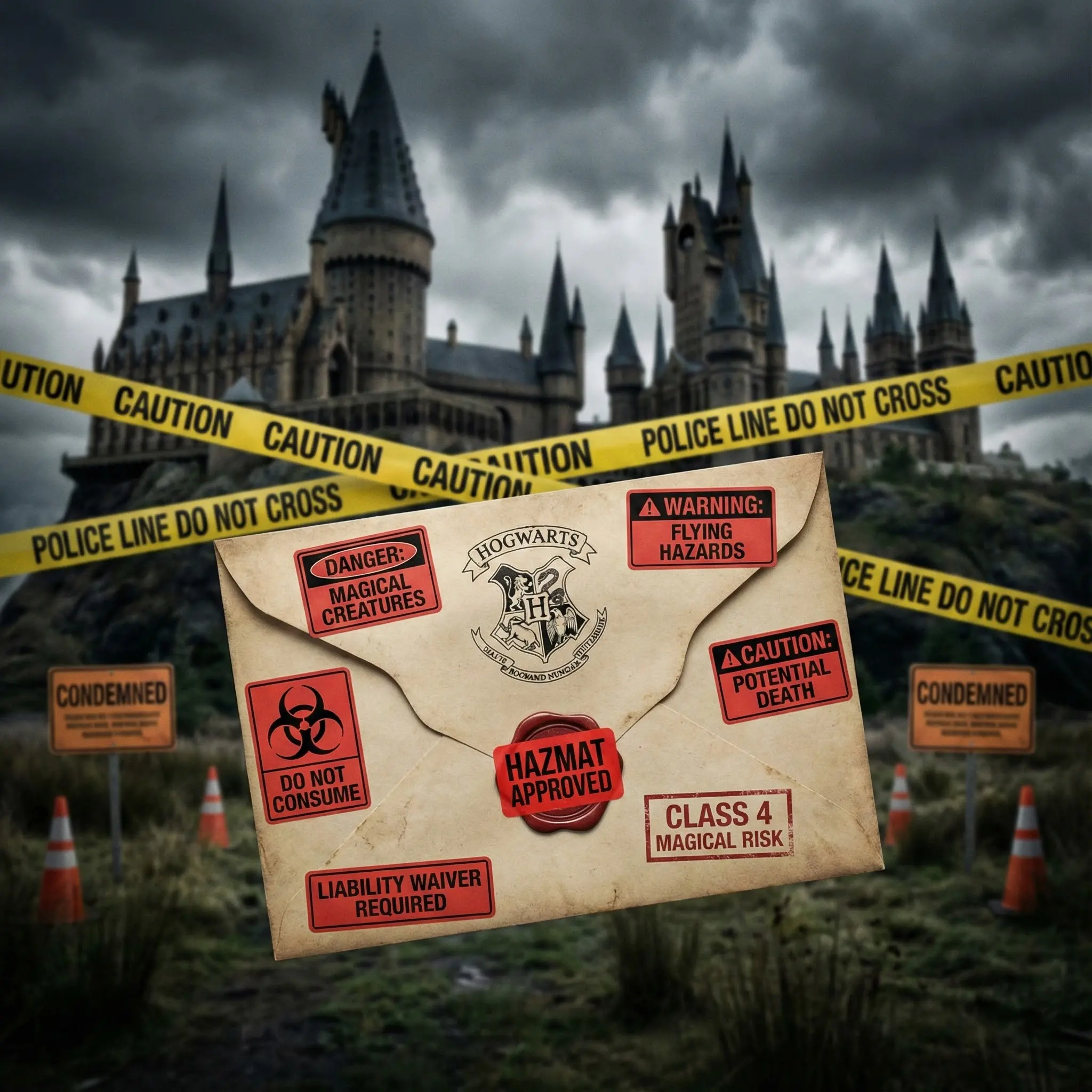

The Acceptance Letter That Should Come with a Waiver
Before you go on! There will definitely be spoilers ahead if you haven’t read the books or seen the movies!
Now, imagine you’re a parent in the wizarding world, and your eleven-year-old just got their Hogwarts letter. You’re probably thinking, “Finally! My child will learn magic at the most prestigious school in Britain!”
What you should be thinking is: “How quickly can I find a good magical lawyer? Does wizard insurance cover death by giant spider?”

Look, I love Harry Potter (read Amina’s full guide to the Wizarding World here). I’m as fond of it as the next person who learned English partly by reading “The Philosopher’s Stone” seventeen times. It’s a true story—my vocabulary was basically ‘wizard,’ ‘spell,’ and ‘expelliarmus’ for months. I’ve read seven books and watched eight movies. In almost every instance, children nearly die on what seems like a weekly basis. I’ve come to a disturbing conclusion. Hogwarts School of Witchcraft and Wizardry is essentially a death trap. It has a really good marketing department.
Let’s be honest here. If Hogwarts existed in our world, health and safety inspectors would shut it down quickly. This would happen faster than you can say “Avada Kedavra.” The fact that parents keep sending their kids there suggests two possibilities. Magical folk may have a very different relationship with child safety. Alternatively, they’ve all been collectively hit with a confusion charm.
I have spent way too much time analyzing fictional schools. This is an occupational hazard of being a pop culture nerd. Here is the definitive reason. Hogwarts is actually the worst possible place to send your magical child.

The Wildlife Situation in Hogwarts: When “Magical Creatures” Means “Things That Want to Kill You”
They Keep a Three-Headed Dog in the School
Let’s start with the most obvious red flag: Fluffy. Yes, they named the massive, three-headed hellhound “Fluffy.” It’s like naming a nuclear bomb “Snuggles”—cute name, still deadly.
This isn’t some carefully contained exhibit in a magical zoo. This is a creature that could literally eat a first-year student in one bite. Yet, it’s kept in a corridor that students regularly wander through. The only security measure? A door that can be unlocked with a simple “Alohomora” spell that first-years learn in their second week.

Hagrid’s defense? “Just don’t go to the third-floor corridor.” That’s it. That’s the entire safety protocol. They basically said, “Hey kids, there’s a monster that could instantly kill you upstairs.” But they thought it was fine because they put up a sign.
In any reasonable educational institution, a three-headed dog would cause immediate evacuation. Extensive safety reviews would follow. There might even be a documentary on Netflix about institutional negligence. At Hogwarts? Just another Tuesday.
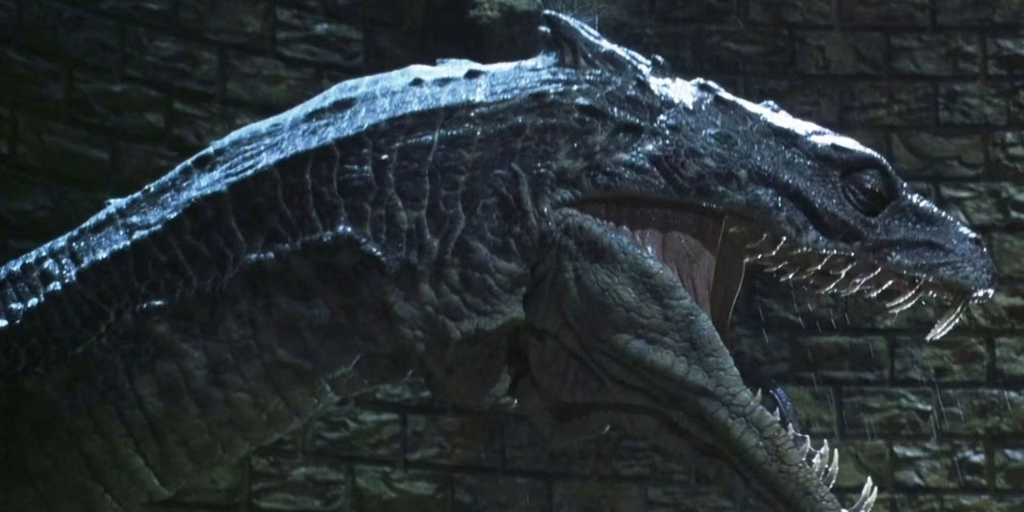
The Forbidden Forest: Where Children Go to Die
Speaking of questionable wildlife management, let’s talk about the Forbidden Forest. It’s called “Forbidden” for a reason—it’s full of creatures that want to murder you. Centaurs, giant spiders, werewolves, and worse lurk in those woods.

So naturally, when students misbehave, where does the school send them for detention? That’s right—directly into the murder forest. With Hagrid, whose idea of a “harmless creature” includes dragons and blast-ended skrewts.
Harry’s first detention involves looking for a wounded unicorn while something is literally drinking its blood in the forest. He’s eleven. ELEVEN. That’s not character building; that’s trauma formation.

Flying Lessons: Because Nothing Says “Safety First” Like Giving Kids Broomsticks
Day One: Here’s a Wooden Stick, Try Not to Die
Forget driver’s education with its months of training and safety courses. At Hogwarts, they hand eleven-year-olds flying broomsticks on literally their first week and say, “Figure it out!” No safety gear, no gradual altitude training, no emergency protocols. Just wood, magic, and the hope that gravity won’t claim another victim.

Neville Longbottom’s first flying lesson ends with him falling off his broom and breaking his wrist. The instructor’s response? “Oh well, these things happen!” In what world is “child falls from significant height and breaks bones” treated as a minor inconvenience?
The fact that flying accidents aren’t more common is honestly miraculous. Magical children either have incredible survival instincts. Or there’s a cover-up happening that would make government conspiracy theorists weep with joy.

Quidditch: The Sport Designed by Sadists
If regular flying lessons weren’t dangerous enough, Hogwarts also features Quidditch. This sport appears to have been designed by someone who thought, “You know what regular sports need? More ways to die.”
Let’s break down the safety hazards:
- Players fly at high speeds with no protective gear beyond basic robes
- One of the balls (the Bludger) is literally designed to attack players
- The goal posts are fifty feet in the air
- Weather conditions include rain, snow, and apparently lightning
- Games continue until someone catches the Snitch, meaning they could theoretically last forever
During Harry’s matches alone, we witness:
- A Bludger that’s been jinxed to specifically target one player
- Dementors causing players to fall from lethal heights
- Lightning storms that would ground any sane sporting event
- A rogue Bludger that breaks a player’s arm

The fact that Quidditch hasn’t been banned by the magical equivalent of OSHA is honestly baffling. It’s like if rugby and extreme sports had a baby. That baby was then raised by wolves with anger management issues.
The Academic Curriculum: Learning Spells That Can Kill You
Defense Against the Dark Arts: Taught by a Different Potentially Dangerous Person Each Year
Here’s a fun game. Name a Defense Against the Dark Arts teacher who wasn’t incompetent or evil. Try to find one who wasn’t actively trying to harm students. I’ll wait.
- Quirrell: Possessed by Voldemort, literally tried to kill Harry
- Lockhart: Fraud who nearly wiped Harry and Ron’s memories
- Lupin: Werewolf (lovely person, slight monthly homicide risk)
- Crouch Jr. (disguised as Moody): Death Eater who tortured students
- Umbridge: Tortured students, used illegal blood quills
- Snape: Emotionally abusive to students for years


This position has a 100% annual turnover rate. That should’ve been a hint. Maybe there’s a curse on it. But does Hogwarts hire carefully screened, qualified instructors? Of course not! They just keep rolling the dice and hoping the next teacher won’t traumatize the children.
Potions Class: Where One Mistake Could Literally Melt Your Face
Potions class sounds harmless. However, these children are brewing substances that can cause permanent transformation. They can also cause memory loss or death. With minimal supervision. Using ingredients that include things like “venom” and “powdered root of asphodel.”
Snape’s teaching method appears to be “intimidate the children until they’re too scared to make mistakes.” This is not sound educational psychology. Fear-based learning in a subject where mistakes can be fatal is basically a recipe for disaster.
The fact that more students haven’t accidentally poisoned themselves speaks more to dumb luck than institutional safety protocols.

Transfiguration: Where You Learn to Turn Your Classmates into Ferrets
McGonagall teaches children to transform living beings into inanimate objects. Let me repeat that: they teach children to turn other living creatures into furniture. What could possibly go wrong?
The potential for abuse here is astronomical. Upset with your roommate? Turn them into a footstool! Don’t like someone’s pet? Boom, now it’s a goblet! The fact that these spells can go wrong and create permanent partial transformations is just icing on the danger cake.

The Administration: Where “Duty of Care” Means “Good Luck!”
Dumbledore’s Leadership Style: Cryptic Neglect
Albus Dumbledore is revered as the greatest wizard of his age. However, his management style would get him fired from a daycare center. His approach to child safety can best be described as “let’s see what happens if we don’t intervene.”
Some of Dumbledore’s greatest hits in child endangerment:
- Allowing known threats to remain in the school for “educational purposes”
- Giving children missions that trained adult wizards would find challenging
- Withholding crucial information that could prevent student deaths
- Hiring teachers he knows are problematic
- Operating under the philosophy that danger builds character
When your headmaster’s favorite phrase is essentially “good luck figuring this out,” you might want to consider alternative educational options.
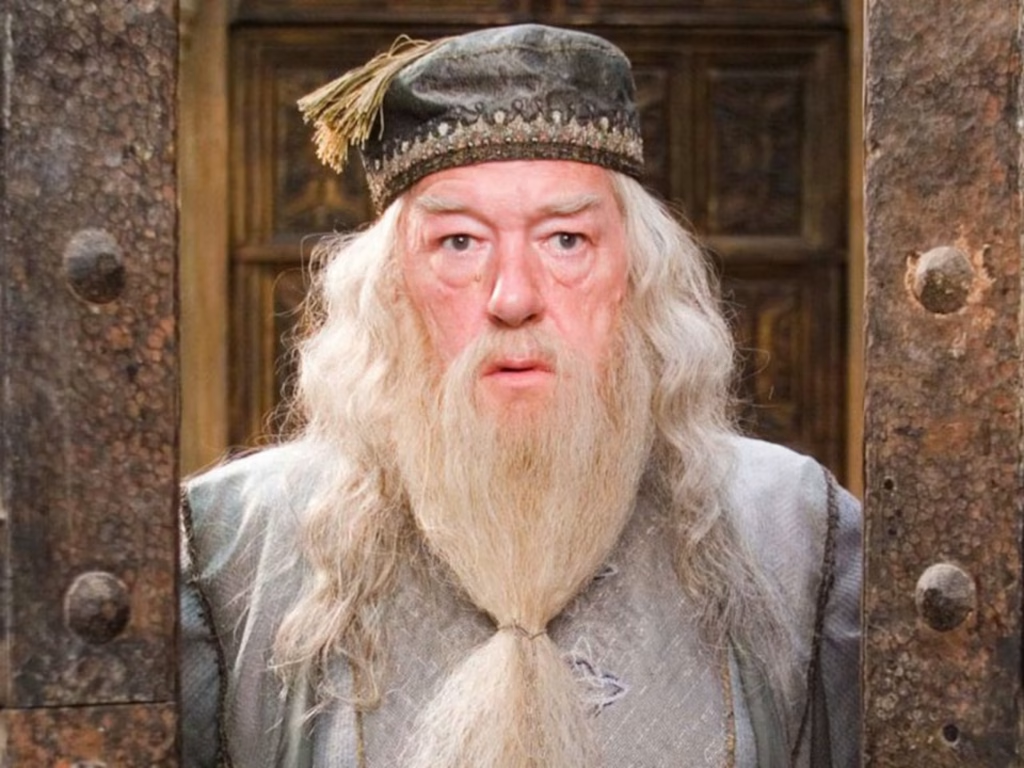
The House System: Institutionalized Favoritism and Bullying
The House system at Hogwarts isn’t just friendly competition—it’s a recipe for tribalism and systematic bullying. You sort eleven-year-olds into groups based on personality traits. Then you pit them against each other for seven years. You’re basically creating a psychological experiment in social dynamics.

One of the houses, Slytherin, is basically known for producing dark wizards. Yet, they continue to maintain it. This suggests some serious institutional problems. It’s like having a college fraternity that’s known for criminal activity but keeping it around because “tradition.”
The Infrastructure: A Castle Designed to Confuse and Harm
Moving Staircases: Because Navigation Should Be a Life-Threatening Challenge
Hogwarts features staircases that move without warning, potentially stranding students or sending them to the wrong floor. This isn’t whimsical magic—this is a mobility accessibility nightmare. What happens if a student is injured and needs to get to the hospital wing quickly? “Sorry, the stairs decided to take a detour!”
Students are expected to navigate this architectural chaos while carrying books and equipment. They are also expected to keep some semblance of punctuality. This is honestly impressive.

Portraits That Gossip and Doors That Require Passwords
Privacy? Never heard of it. The portraits at Hogwarts watch everything and gossip about student activities. Meanwhile, getting into your own dormitory requires remembering an ever-changing password. What happens if you forget? You sleep in the hallway, apparently.
The Fat Lady literally abandons her post when she’s scared, leaving Gryffindor students locked out of their own common room. This is not secure access management; this is chaos with a veneer of magic.
The Medical Care: Magical Healing Can’t Fix Institutional Negligence
Madam Pomfrey: One Nurse for 1,000+ Students
Hogwarts employs exactly one medical professional for the entire school. One. Madam Pomfrey is clearly competent and caring. She’s effectively managing a one-woman emergency room. This is for a population of magical teenagers who regularly engage in life-threatening activities.
The ability she has to regrow bones overnight is incredible. However, it does not excuse the institutional negligence. This negligence keeps breaking those bones in the first place. It’s like having amazing car insurance but removing all the safety features from vehicles—technically fixable, completely irresponsible.
The “Magical Healing Fixes Everything” Mentality
The wizarding world’s approach to safety seems to be “well, we can probably fix it magically afterward.” This is like saying you don’t need seatbelts because hospitals exist. The ability to heal injuries doesn’t negate the responsibility to prevent them.
Plus, what about injuries that can’t be magically healed? Psychological trauma, curse damage, or just plain old bad experiences? Hogwarts doesn’t appear to have any mental health resources, despite regularly exposing children to life-threatening situations.
The Competition Factor: Turning Education into Survival Games
The Triwizard Tournament: “Let’s Watch Teenagers Risk Death for Sport”
The Triwizard Tournament was discontinued for centuries because it was too dangerous, then brought back with “enhanced safety measures.” Those safety measures apparently consisted of hoping for the best and having a really good medical team on standby.
Tasks include fighting dragons, underwater rescue missions with real drowning risks, and navigating a maze filled with dangerous creatures. These aren’t educational challenges; they’re survival scenarios that trained adult wizards would find daunting.

They allowed a fourteen-year-old to compete, even unwillingly. Then they shrugged and said “well, magical contract.” This shows a stunning lack of both common sense and basic child protection principles.

House Cup Competition: Because Healthy Competition Includes Risk of Death
The House Cup isn’t just academic achievement—it includes points for facing mortal peril. Harry, Ron, and Hermione win points for stopping Voldemort, facing a mountain troll, and other death-defying acts. This creates a perverse incentive structure where students are rewarded for putting themselves in danger.
Imagine if your regular school gave extra credit for wrestling bears or defusing bombs. That’s essentially what Hogwarts does, just with a magical twist.

The Social Environment: Where Bullying Includes Curses
Magical Bullying: When “Kids Will Be Kids” Involves Actual Spells
Regular school bullying is bad enough, but at Hogwarts, bullies have access to magic. Students can be cursed, jinxed, or hexed by their classmates, with effects ranging from embarrassing to genuinely harmful.
The Marauders’ bullying of Severus Snape included hanging him upside down and exposing his underwear to a crowd using magic. This isn’t boys being boys; this is magical assault with a captive audience.
Such incidents are treated as pranks instead of serious violations. This approach shows a concerning attitude toward consent and personal safety.
Inter-House Rivalry: Prejudice as School Spirit
The house system doesn’t just create friendly competition—it actively encourages prejudice and stereotyping. Students are sorted based on perceived personality traits and then taught to compete against other houses for seven years.
The Slytherin house faces particular discrimination, with other houses treating them as inherently evil or dangerous. This creates a self-fulfilling prophecy where students live up to negative expectations and institutional bias.

The Communication Breakdown: When “Need to Know” Means “Total Information Blackout”
Keeping Parents in the Dark
Hogwarts has a shocking lack of parental communication. When do parents find out about the various life-threatening situations their children face? Usually after the fact, if at all.
“Dear Mr. and Mrs. Potter, thought you should know that Harry faced a three-headed dog. He also faced a troll. Additionally, he encountered the disembodied spirit of the Dark Lord this term. He’s fine! See you at Christmas!” is not adequate parental notification.
Any reasonable parent would want regular updates about their child’s safety. This is especially true in an environment where danger is apparently a daily occurrence.
The “Students Will Figure It Out” Philosophy
Rather than providing clear guidance and safety protocols, Hogwarts often leaves students to figure out dangerous situations on their own. This isn’t character building; it’s institutional negligence with extra steps.
When children are regularly expected to solve adult-level problems without adult support, you’re not creating independence—you’re creating trauma.

The Real-World Implications: What This Says About Wizard Society
Normalization of Danger in Child-Rearing
Wizard parents continue sending their children to Hogwarts despite its safety record. This suggests that magical society has a fundamentally different relationship with risk and child welfare.
Magical children are significantly more resilient than their muggle counterparts. Alternatively, wizard society has normalized levels of danger. These levels of danger would be unacceptable in the non-magical world.
The Insurance Nightmare
Can you imagine trying to get liability insurance for Hogwarts? The risk assessment alone would be a document longer than the entire Harry Potter series.
Risks include, but are not limited to, magical creature attacks and flying accidents. There may also be curse-related injuries and exposure to dark magic. Psychological trauma can result from supernatural encounters. There is a potential risk of death by various magical means.
Different Educational Options: Because Magic Doesn’t Require Mortal Peril
Beauxbatons Academy: Where Elegance Doesn’t Include Death Traps
Beauxbatons appears to focus on refinement and magical arts without the constant threat of student mortality. Their students arrive in a flying carriage (with safety features!) and seem generally well-adjusted and alive.
Durmstrang Institute: Questionable Ethics, Better Safety Record
Even Durmstrang, despite its reputation for teaching dark arts, seems to have fewer student casualties than Hogwarts. Their students appear competent and confident without the shell-shocked thousand-yard stare common among Hogwarts alumni.
Homeschooling: Ancient Magic, Modern Safety Standards
Many wizard families successfully educate their children at home without exposing them to weekly life-threatening situations. Revolutionary concept: learning magic in an environment where the greatest danger is paper cuts from spell books.
The Hogwarts Alumni Perspective: Survivors Tell All
Post-Traumatic Success Syndrome
Hogwarts graduates often go on to successful careers, which the school points to as evidence of their educational quality. But correlation isn’t causation—these students succeeded despite their education, not because of it.
They survived seven years of magical hazards. This experience probably prepared them for anything the working world could throw at them. It’s like saying military boot camp is great education. Soldiers become disciplined workers, which is technically true. However, there might be less traumatic ways to achieve the same results.
The “Character Building” Myth
Supporters of Hogwarts often argue that danger builds character and prepares students for real life. But there’s a difference between age-appropriate challenges and genuine life-threatening situations.
Twelve-year-olds don’t need to face down basilisks to learn courage. They can develop bravery through appropriate challenges. These challenges don’t risk death or permanent injury.
A Better Way Forward: Reform Recommendations
Comprehensive Safety Review
A complete safety audit by qualified magical safety experts would start any reasonable reform. These experts should not be employed by the school. Every dangerous creature, unsafe practice, and hazardous area should be identified and addressed.
Professional Development for Faculty
Teachers should receive training in both their subject matter and child safety. Snape’s emotional abuse, Lockhart’s incompetence, and various other faculty issues suggest serious problems with hiring and oversight.
Updated Infrastructure
Moving staircases need either safety features or replacement with static alternatives. Clear signage, emergency protocols, and basic accessibility features should be standard.
Mental Health Support
Students facing regular supernatural threats need psychological support. One nurse for the entire school is inadequate—Hogwarts needs counselors, therapists, and trauma specialists.

The Final Verdict: Love the Magic, Question the Methods
Don’t get me wrong—I absolutely love the Harry Potter universe. The magic, the friendships, the coming-of-age stories, the way it taught millions of kids that reading can be an adventure. J.K. Rowling created something genuinely magical that has enriched countless lives.
If we’re being honest about the institutional practices at Hogwarts School of Witchcraft and Wizardry, the place is risky. It is a lawsuit waiting to happen. It also comes with a side of child endangerment charges.
Harry, Ron, Hermione, and their classmates became decent, capable adults. This speaks more about their resilience and the power of friendship than it does about their educational institution. They succeeded not because of Hogwarts’ teaching methods. Instead, they found each other and learned to support one another through impossible circumstances.
As a parent (hypothetical wizard parent, but still), I’d want my magical child to learn in a nurturing environment. This environment should enhance their abilities. It should not regularly risk their life. Magic is wonderful; trauma is not a required educational component.
Where to Send Your Magical Child Instead
If you’re a wizard parent looking for alternatives that prioritize both magical education and basic child safety:

Consider Beauxbatons for elegant magical education with a focus on arts and culture—and notably fewer student casualties.

Look into Ilvermorny for a fresh start in magical education without centuries of accumulated dangerous traditions.
Explore homeschooling options with qualified magical tutors who understand that learning doesn’t require mortal peril.
Investigate correspondence courses from accredited magical institutions that don’t require residential stays in potentially haunted castles.
Remember: magical education should expand your child’s mind, not traumatize it. There are plenty of ways to learn magic that don’t involve weekly near-death experiences.
Your child’s safety is not an acceptable sacrifice for tradition. This holds true regardless of how prestigious the institution is or how beautiful the castle appears.
Sometimes the most magical thing is ensuring your kids come home alive. This is especially true at the end of the school year.
Harry Potter and all related characters, names, marks, emblems and images are trademarks of J. K. Rowling and Warner Bros. This content is transformative commentary and review material created by Fandoria and is not affiliated with or endorsed by the companies mentioned.


Leave a Reply